


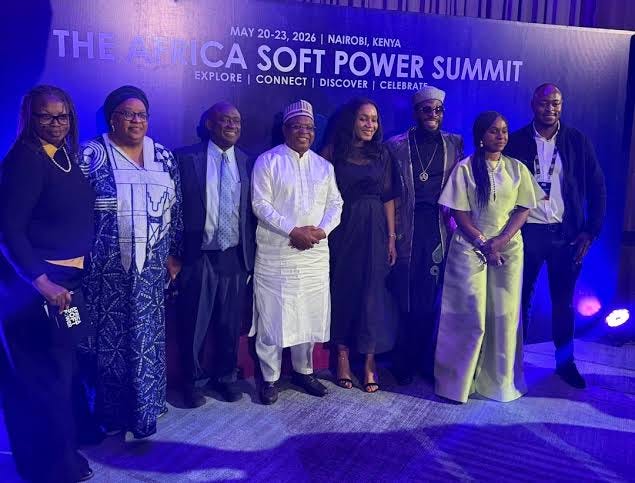
When Umaru Kwairanga, Chairman of the Nigerian Exchange Group, stood on stage at the Africa Soft Power Summit in Nairobi and called on African capital markets to take the creative economy seriously as an investment asset class, it was easy to focus on what he said.
The more interesting question may be why he was saying it at all.
Because for most of Africa’s modern economic history, the people running stock exchanges did not spend much time discussing musicians.
They did not spend much time discussing filmmakers.
They did not spend much time discussing creators, fashion designers, gaming studios, storytellers, or intellectual property.
Stock exchanges financed banks.
Banks financed manufacturers.
Investors analysed mining companies.
Governments prioritised agriculture, telecommunications and energy.
Culture existed largely outside those conversations.
It was important.
It was celebrated.
But it was rarely treated as a core economic sector.
That appears to be changing.
But because institutions are finally beginning to recognise value that has existed for years.
And perhaps the most important development in Africa’s creative economy today is not what creators are doing.
It is who is paying attention.
A Different Kind of Audience Has Entered the Room
The Africa Soft Power Summit has always occupied an unusual position in the continent’s conference landscape.
Unlike traditional creative industry events, it deliberately places finance, technology, policy, culture and business inside the same conversation. The 2026 edition focused heavily on the intersection of creativity, capital, technology and ownership.
That matters because it reflects a broader shift happening across Africa.
The people showing up to creative economy conversations are changing.
A decade ago, discussions about African music might have centred around artistic quality.
Today those same discussions increasingly involve export earnings, copyright systems, intellectual property monetisation and infrastructure.
A decade ago, conversations about film focused largely on storytelling.
Today they increasingly involve streaming economics, investment structures and distribution networks.
A decade ago, creator economies barely existed as a policy category.
Today governments are designing creator-focused programmes, development institutions are funding creative ventures and technology companies are building creator tools.
The audience has changed.
And when the audience changes, the conversation usually changes too.
The Creative Economy Has Moved Beyond Awareness
One of the dominant arguments surrounding Africa’s creative economy was visibility.
The continent needed recognition.
Its artists needed exposure.
Its stories needed distribution.
Its creators needed global audiences.
In many respects, that battle has already been won.
African music has become a global force.
African fashion increasingly appears on international runways.
African filmmakers are securing global distribution deals.
African creators are building audiences that extend far beyond national borders.
The challenge today is different.
It is no longer primarily about visibility.
It is about ownership.
That theme surfaced repeatedly throughout discussions at the Africa Soft Power Summit, where speakers argued that Africa’s next challenge is not simply producing influence but controlling more of the infrastructure, platforms, capital and institutions through which that influence generates value.
That is a fundamentally different conversation.
Visibility is cultural.
Ownership is economic.
Institutions Are Following The Money
One reason financial institutions are paying closer attention is simple.
The creative economy has become too large to dismiss.
Globally, cultural and creative industries generate trillions of dollars in economic activity and support millions of jobs. Across Africa, music, film, fashion, gaming and digital content are increasingly contributing to employment, exports and entrepreneurship.
Afreximbank’s response illustrates this shift clearly.
In 2024, the bank announced plans to double funding for its Creative Africa Nexus (CANEX) programme from $1 billion to $2 billion, citing growing demand across sectors ranging from music and film to fashion and sports.
That is not philanthropic behaviour.
It is investment behaviour.
And it reflects a broader institutional realisation.
Creativity is no longer sitting at the edge of the economy.
It is becoming part of the economy’s growth engine.
The institutions are not creating this shift.
They are responding to it.
Culture Is Becoming An Economic Category
Perhaps the biggest transformation is conceptual.
Historically, culture and economics occupied separate rooms.
Culture was discussed through identity, heritage and artistic expression.
Economics was discussed through GDP, capital formation and industrial growth.
Increasingly, those rooms are merging.
Consider the range of sectors now being pulled into creative economy discussions:
intellectual property
digital platforms
AI training data
creator businesses
streaming infrastructure
audience analytics
licensing systems
tourism
cultural exports
These are not traditionally cultural topics.
Nor are they purely technological or financial topics.
They sit at the intersection of all three.
That intersection is becoming one of the most important economic battlegrounds of the next decade.
Why This Moment Feels Different
Africa has experienced creative economy optimism before.
What feels different today is the institutional density forming around the sector.
The conversation is no longer being driven solely by creators.
It increasingly includes:
stock exchanges
export-import banks
technology companies
venture capital firms
development finance institutions
ministries of finance
regulators
When multiple institutions begin converging around the same sector, it usually signals a structural transition.
Not a trend.
Not a moment.
A transition.
The same process happened with telecommunications.
It happened with fintech.
It happened with renewable energy.
The conversation moved from enthusiasts to institutions.
The creative economy appears to be entering a similar phase.
The Real Story Isn’t About Creators
Ironically, the most revealing story in Africa’s creative economy right now may not be about creators at all.
Creators have been building value for years.
Musicians have been exporting culture.
Filmmakers have been building industries.
Designers have been expanding markets.
The new development is that institutions are finally starting to behave as though those activities matter economically.
That is why a stock exchange chairman discussing Afrobeats is noteworthy.
Not because he suddenly discovered music.
But because the institutions he represents are beginning to recognise something creators have understood for a long time.
Culture is not simply expression.
It is infrastructure.
And when the people who allocate capital start talking about culture differently, it often means the economy itself is starting to see it differently too.
The most interesting thing about Africa’s creative economy is no longer what it produces.
It is who has started paying attention.

Written by Layo
Lead Editorial Writer, Creative Brief Africa
Outside of her editorial work, she writes Curious Health, a newsletter focused on everyday health questions, explored with clarity and care.