


In 2023, MTV introduced the Best Afrobeats category at the Video Music Awards.
It was the kind of institutional validation the genre had been building toward for years. Rema and Selena Gomez won the inaugural award for Calm Down. Tyla won the next two, in 2024 and 2025, with Water and Push 2 Start. Three editions. Two winners. One category that the whole industry pointed to as proof that Afrobeats had arrived at the centre of global pop culture.
In August 2026, MTV dropped the category entirely from the VMA nominations. No explanation. No statement. Nine categories were cut in total, including Best Rock and Best Pop Artist, but none of the others carried the same symbolic weight for an industry that had invested in the category as evidence of its global legitimacy.
Burna Boy still got a Best Collaboration nomination alongside Shakira for Dai Dai. Tems got a Best R&B nod with Dave. African artists were present in the 2026 VMAs. Just without a dedicated home.
That is the shape of the problem the African music economy keeps running into. The cultural influence travels. The institutional recognition is contingent. And the revenue, the part that actually determines whether an artist can build a career and a country can build an industry, follows a logic of its own that cultural influence alone does not automatically unlock.
The Revenue Map Does Not Match the Sound Map
The IFPI’s Global Music Report 2026 confirmed what the industry already knew and had not fully confronted.
Sub-Saharan Africa’s recorded music revenues grew 15.2% in 2025, reaching $120 million. That is the joint second-fastest growth rate of any region globally, alongside the Middle East and North Africa. Eleven consecutive years of global industry growth. Africa is part of the story.
And then the next sentence.
South Africa accounted for 78.1% of that $120 million.
One country. 78.1%.
That means the remaining 53 sub-Saharan African countries, including Nigeria, the country whose sound has arguably done more than any other to drive Afrobeats into global pop culture over the past decade, collectively generated approximately $26 million in formal recorded music revenue in 2025.
Nigeria is not a small music market. It produces an estimated 2,500 to 3,000 songs daily. Its artists fill arenas in London, Paris, Toronto, and New York. Its musical vocabulary, the Afrobeats sound, the Afropop production aesthetic, has shaped global pop music in ways that are documented in streaming data, chart placements, and the production credits of international hits.
And it accounts for a fraction of the formal revenue its cultural influence should be generating.
The gap between those two facts is not a music problem. It is an infrastructure problem.

Why South Africa Captures the Revenue Nigeria Does Not
South Africa’s music market did not become the dominant formal revenue generator in sub-Saharan Africa because its music is more globally influential than Nigeria’s. It became dominant because its market infrastructure is more developed.
South Africa has a functioning collecting society in SAMRO, which has operated a transparent royalty collection and distribution system for decades and has reciprocal agreements with international performing rights organisations that allow South African artists to receive royalties generated by their music globally. It has a banking and payment infrastructure that processes royalties without the friction that plagues cross-border payments in West and Central Africa. It has a formal streaming economy with higher ARPU because the rand, despite its own volatility, operates within a payment infrastructure that global platforms have integrated more completely than they have integrated the naira or the West African franc.
These are structural advantages. They are not artistic ones.
The implication for Nigeria and for West African music markets more broadly is uncomfortable. Cultural dominance does not automatically translate into economic dominance when the infrastructure required to convert cultural activity into formal revenue is absent or underdeveloped.
Afrobeats is not struggling to find an audience. It is struggling to build the collection and distribution infrastructure that would allow the audience it has already found to generate proportional revenue for the artists and markets that created it.
What Côte d’Ivoire’s Numbers Say
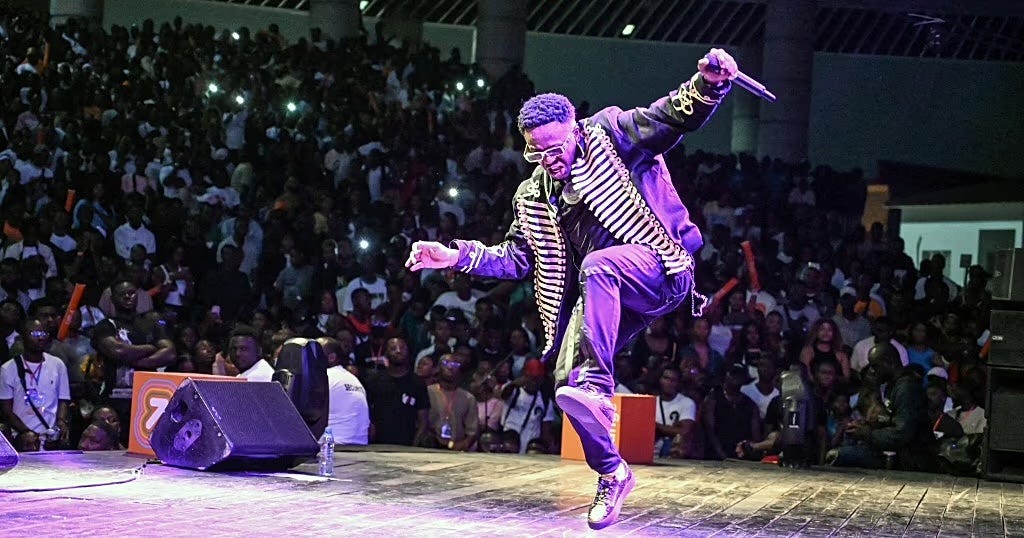
Abidjan is one of West Africa’s most significant music markets. Côte d’Ivoire’s Afrobeats scene, rooted in the specific sound of Coupé-Décalé and the broader Ivorian musical tradition, has produced artists and cultural exports that travel across Francophone Africa and beyond.
BURIDA, Côte d’Ivoire’s collecting society, distributed 299 million FCFA to 2,766 beneficiaries in June 2026. Approximately $490,000. The June 2025 distribution had been 315 million FCFA, meaning the June 2026 round was lower than the previous year’s equivalent.
The September 2026 round was significantly larger, at 795 million FCFA, and included a substantial amount of pending rights, money BURIDA had already collected but had been unable to distribute because the documentation required to match payments to rightholders had not been completed. Nearly 650 million FCFA of the September total was money the society had been holding, released only when the paperwork caught up.
That detail is the structural story in miniature.
African collecting societies are collecting money. The friction is in distribution. Documentation gaps, incomplete rights registration, administrative backlogs, and the challenge of matching streaming data from global platforms to the local rights holders those streams are supposed to pay. The money exists somewhere in the system. It does not reliably reach the artist who created the work.
BURIDA itself acknowledged the documentation problem publicly, calling on creators to register their works more completely so future distributions can include them. The society is not failing to collect. It is failing to distribute efficiently, and the reason is not negligence. It is the absence of the data infrastructure, the rights registration systems, the metadata standards, and the global platform integrations that would allow automatic matching of plays to payments.

The Global Validation Trap
The MTV VMA category story is worth returning to because it illustrates something specific about how African music’s relationship with global institutions works.
The Best Afrobeats category was introduced in 2023 when Afrobeats had already been commercially dominant for several years. The category was, in this sense, a lagging indicator. Global pop culture had already absorbed the sound. The institutional recognition came afterwards.
When the category was dropped three years later, the industry’s response treated it as a setback. Fans expressed concern that removing the category would limit opportunities for African artists. That reaction is understandable. But it also reveals a dependence on external validation that sits uncomfortably alongside the scale of Afrobeats’ actual global influence.
Burna Boy is nominated at the 2026 VMAs without a dedicated Afrobeats category. He is competing in mainstream categories alongside the biggest names in global pop. That is arguably a more significant position than winning a regional category. The question of whether it is better to have a dedicated category or to be integrated into the main programme is genuinely contested, and African artists themselves are divided on it.
But the deeper point is that institutional validation from Western awards bodies, whether it arrives or disappears, should not be the primary measure of African music’s economic health. The $120 million in formal sub-Saharan African recorded music revenue exists regardless of the VMA category. The infrastructure gaps that concentrate 78.1% of it in South Africa exist regardless of the VMA category. The royalty distribution delays in Côte d’Ivoire exist regardless of the VMA category.
The global recognition is real. It has commercial consequences in terms of streaming numbers, licensing opportunities, and brand deal access. But it is not a substitute for the formal market infrastructure that converts cultural influence into durable economic value.
What Closing the Gap Actually Requires
The revenue gap between African music’s global cultural influence and its formal economic returns is not closing by itself.
It requires collecting societies with the data infrastructure to match global streaming plays to local rights holders automatically, not quarterly, not with documentation backlogs, not with half the beneficiaries excluded because their works are not registered in the formats that international platforms recognise. SAMRO’s relative efficiency in South Africa is the model. Building equivalent infrastructure in Nigeria, Ghana, Côte d’Ivoire, Kenya, and Senegal is the work.
It requires platform integration that goes deeper than market presence. Spotify and Apple Music are available across Africa. The per-stream rates they pay in African markets remain significantly below Western equivalents, which means the streaming growth that IFPI is reporting is not delivering proportional revenue per stream to African artists. That gap requires both platform policy change and the negotiating infrastructure to demand it, which collecting societies and music industry bodies across the continent are still in the process of building.
It requires rights registration at scale. BURIDA’s September 2026 distribution included 650 million FCFA of pending rights that had been collected but not distributed because the documentation was incomplete. Every franc of that money represents a creator whose work was played, whose rights were collected, and who waited months or years to receive payment because the administrative infrastructure between collection and distribution was not built for the volume or the complexity of the market it serves.
And it requires a clear-eyed understanding of what global validation is and is not.
The MTV VMA Best Afrobeats category ran for three years and produced two winners. It was never the mechanism by which Nigerian or West African music was going to build a formal revenue economy. The mechanism for that is infrastructure. Rights registration. Transparent collecting societies. Platform rate negotiations. Banking integration that allows royalties to move across borders without losing significant value to friction.
Those things do not generate press coverage the way a VMA win does.
They are the difference between African music being globally heard and African music being economically owned by the people who made it.

Written by Layo
Lead Editorial Writer, Creative Brief Africa
Outside of her editorial work, she writes Curious Health, a newsletter focused on everyday health questions, explored with clarity and care.