


Africa is not struggling to imagine fashion.
It is struggling to industrialise it.
Across global runways, fashion weeks, luxury collaborations, and cultural conversations, African designers are visible, influential, and increasingly central to how the world defines “new luxury.” Their work shapes silhouettes in Paris. Their textiles inspire collections in Milan. Their stories fuel editorials in New York.
Yet walk through markets across Lagos, Accra, Nairobi, Johannesburg, or Dakar, and the clothes being worn are overwhelmingly imported.
This contradiction is not aesthetic.
It is structural.
The problem is not that Africa lacks designers. It is that African fashion has been allowed to grow creatively without growing industrially, and that gap now defines who captures value.
We have mastered expression.
We have neglected execution.
And in fashion, execution is where money lives.
A $50 Billion Industry Africa Does Not Control
The African fashion market is projected to reach $50 billion by 2030. Development banks, trade bodies, and industry analysts repeat this figure as proof that African fashion has “arrived.”
But market size does not equal manufacturing power.
Visibility does not equal ownership.
Design output does not equal production control.
Africa can influence global fashion while still importing the majority of what it consumes. That is exactly what is happening.
Most African countries remain net importers of finished garments, even while exporting designers, aesthetics, and raw materials. The money circulates. The value does not stay.
We sell cotton.
We import fabric.
We export inspiration.
We import inventory.
The continent participates in fashion’s cultural economy, but remains peripheral in its industrial one.
This is how you become visible without becoming powerful.
Designers Travel Easily. Factories Do Not.
African designers are global because creative labour is mobile.
A designer can relocate.
Collaborate remotely.
License their name.
Plug into existing global supply chains.
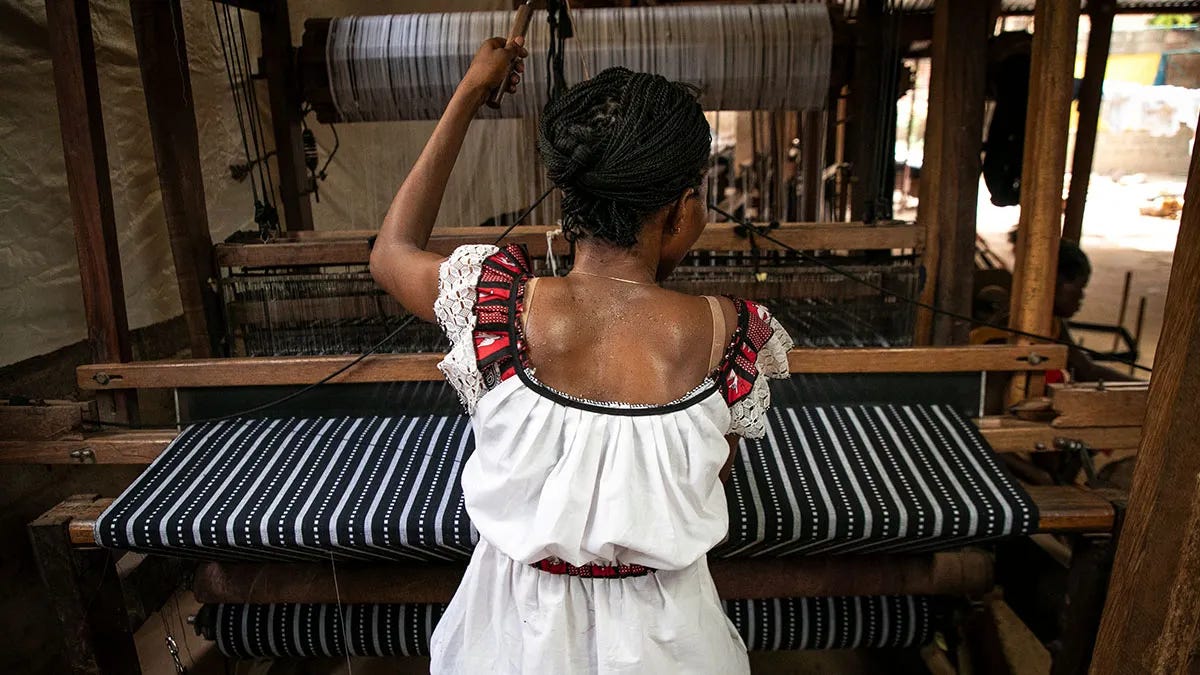
Production cannot do the same.
Factories require fixed capital, reliable electricity, skilled labour at scale, stable logistics, predictable policy, and time. They depend on systems that must work consistently, not occasionally.
Where those conditions are weak or fragmented, production becomes expensive, slow, and risky.
So designers leave.
Or outsource.
Or split their operations.
This is not failure. It is rational behaviour inside a broken system.
A young designer in Lagos can sketch a world-class collection. But to produce it at scale, on time, at a competitive cost, she often has to look outside her country. Not because she rejects local production, but because local production cannot meet her ambition.
Creativity becomes exportable.
Industry remains immobile.
This is how ecosystems hollow out while talent flourishes.
The Colonial Logic That Never Left
The gap between African design and African production did not emerge by accident.
Colonial trade systems positioned African economies as:
exporters of raw materials
importers of finished goods
consumers, not manufacturers
Cotton grown in Africa was processed elsewhere and re-imported as fabric or clothing. Political independence did not dismantle this structure. Globalisation refined it.
Today, Africa still exports raw cotton while importing textiles.
It exports creative direction while importing mass production.
It exports inspiration while importing inventory.
Fashion simply made this imbalance more visible.
The industry mirrors a deeper economic pattern. Africa participates at the beginning and end of value chains, but is absent from the middle, where transformation, scaling, and profit occur.
Design is celebrated.
Manufacturing is neglected.
Value escapes.
Education Without Absorption
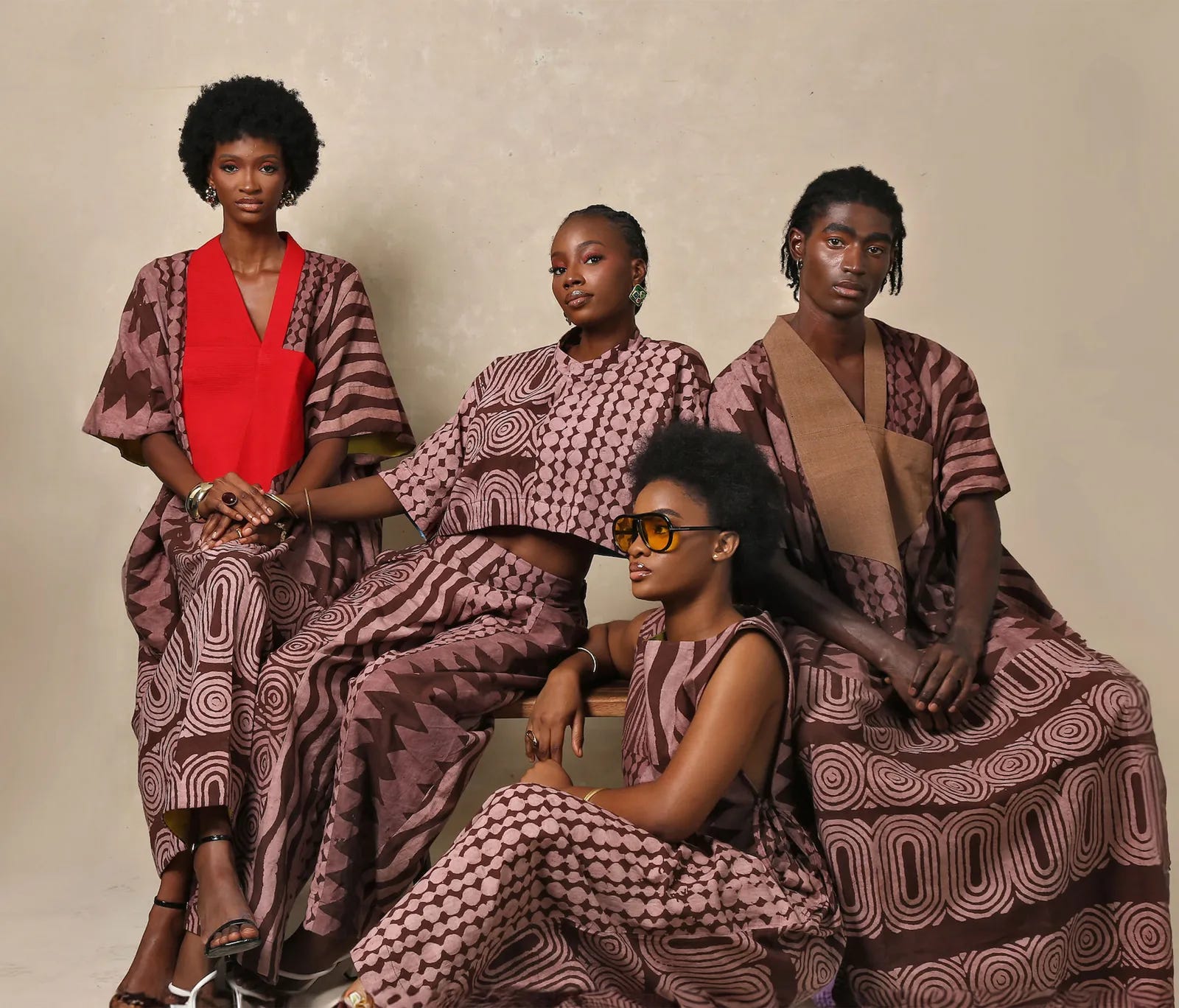
Over the last decade, fashion schools, incubators, and creative programs across Africa have multiplied. Designers are trained in concept, storytelling, garment construction, branding, and runway presentation.
The talent pipeline is no longer the bottleneck.
But education without industrial absorption produces a familiar outcome.
Graduates enter markets where:
textile mills are scarce
production volumes are limited
costs are high
timelines are unstable
Scaling locally becomes impossible.
Designers face two options. Stay small and survive, or outsource and grow. Many choose the latter, not because they reject local production, but because local production cannot sustain momentum.
They want consistency.
They want predictability.
They want growth.
The system offers survival.
So they leave.
Not physically always. Sometimes structurally. They remain African designers with non-African production.
This is how creative ecosystems become export pipelines.
Why Investment Keeps Missing the Point
African fashion is not underfunded.
It is misfunded.
Investment flows disproportionately toward:
fashion weeks
international showcases
branding and visibility
awards and cultural recognition
These matter. They shape narrative. They build prestige. They open doors.
But they do not build factories.
Manufacturing infrastructure, textile innovation, shared production hubs, and supply-chain financing receive far less attention. The result is success for individual designers without transformation of the system beneath them.
We build stages.
We do not build systems.
Africa ends up with global fashion stars and local production gaps at the same time.
Visibility without leverage.
The industry becomes performative. Beautiful. Applauded. Fragile.
The Second-Hand Distortion
Another force quietly widening the gap is second-hand clothing.
Cheap imported garments flood African markets, reshaping consumer expectations around price, durability, and disposability. Locally produced clothing struggles to compete, not because it lacks quality, but because it cannot match the economics of mass-imported used apparel.
This distorts the market.
Manufacturers see thin margins and high risk.
Investors see instability.
Designers see limited scale.
Consumers become accustomed to abundance without production.
Consumption grows.
Production stalls.
An entire generation learns that clothing is cheap, disposable, and external. The idea that garments are made nearby, by people in your community, begins to feel foreign.
This is not just an economic problem.
It is cultural conditioning.

What Changes When Production Is Treated as Strategy
The few African fashion ecosystems showing progress share one trait. They treat production as strategy, not afterthought.
Shared manufacturing hubs reduce costs across multiple designers.
Regional textile initiatives create predictable input supply.
Financing aligned with fashion production cycles allows planning beyond survival.
When production becomes viable, designers stay.
When designers stay, demand stabilises.
When demand stabilises, factories invest.
Value begins to circulate locally.
This is how fashion shifts from spectacle to industry.
It stops being about moments.
It becomes about systems.
Creativity no longer floats above infrastructure. It plugs into it.
What Other Regions Got Right
Italy did not dominate fashion through branding alone. It built dense networks of specialised manufacturers, each perfecting a single stage of production.
Bangladesh and Vietnam did not become garment powerhouses through aesthetics. They aligned policy, capital, and export strategy.
China did not win through talent. It integrated textiles, manufacturing, and logistics vertically.
These systems were built deliberately.
They required:
patient capital
coordinated policy
long-term planning
cultural respect for production
African fashion has focused on expression.
Other regions focused on execution.
One creates admiration.
The other creates dominance.
The Question Africa Keeps Avoiding
Africa does not need more designers.
It needs fewer excuses for why production is still optional.
The real question is not why Africa exports designers and imports clothes.
It is why production has never been treated with the same seriousness as creativity.
Why is manufacturing still framed as secondary?
Why is infrastructure still seen as government’s problem?
Why is fashion allowed to exist as culture without existing as industry?
Until manufacturing, textiles, and supply chains are positioned as core creative infrastructure, Africa will remain visible but dependent, admired but underpaid.
The $50 billion future being projected will exist.
The question is where the money will live.
Why This Matters Now
Fashion is not just clothing. It is jobs, trade balance, IP, and industrial skill. It trains machinists, pattern cutters, textile engineers, quality controllers, logistics managers. It builds export capacity. It anchors communities.
If Africa cannot convert cultural power into production power, the same pattern will repeat across film, music, gaming, and digital creativity.
Creation without capture is not growth.
It is leakage.
Until the gap between African design and African production is closed, Africa will keep dressing the world without dressing itself.
Not because it lacks vision.
But because it never decided that execution was part of creativity.

A guest post by
A curious mind exploring the crossroads of creativity and insight.