


Forbes released its fifth annual Top Creators list this week, and the headline number is the kind that makes an industry feel official: the 50 highest-earning social media stars in the world collectively pulled in $1.02 billion between March 2025 and March 2026. That is a 20% jump from $853 million the year before, and an 80% increase from the $570 million the inaugural list recorded in 2022.
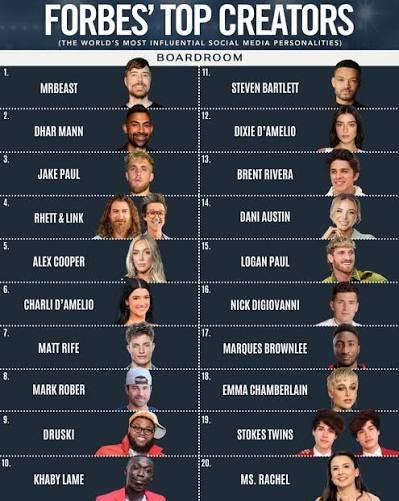
MrBeast — Jimmy Donaldson — retained the top spot for the fifth consecutive year, with an estimated $300 million in earnings from a business empire that now spans YouTube, the Feastables and Lunchly food brands, the Viewstats analytics platform, and Amazon Prime’s Beast Games. Dhar Mann came in second with $65 million. Steven Bartlett, the Diary of a CEO host, rounded out the top three with $52 million. The rest of the top 20 reads like a cross-section of where global digital attention now lives: Markiplier, Rhett & Link, Charli D’Amelio, Druski, IShowSpeed, Mark Rober, Codie Sanchez, and Alix Earle.
Scroll the full list of 50, and one name carries the weight of an entire continent’s presence in this economy.
Khaby Lame, and Almost No One Else
Khaby Lame — born in Senegal, raised in Italy — ranked 15th on this year’s list with an estimated $9.9 million in earnings. He remains TikTok’s most-followed creator, with 252.1 million followers across platforms and an average engagement rate of 4.72%, built almost entirely on wordless reaction videos that require no translation to travel across borders. His brand partnerships include Hugo Boss and Binance, alongside Hollywood studio deals.
His placement is being reported across African media as evidence that the continent has arrived in the global creator economy. It is also, on closer inspection, the entire extent of that arrival. Among 50 names spanning gaming, comedy, lifestyle, finance, fitness, food, and tech, Khaby Lame is the only creator with African origin on Forbes’ list. No Nigerian creator. No Kenyan creator. No South African, Ghanaian, or Egyptian creator — despite all four countries having genuinely large, commercially active creator economies and despite Nigeria’s Afrobeats and Nollywood ecosystems demonstrating that African digital content can travel globally and monetize at scale.
This is worth sitting with for a moment, because it cuts against the prevailing narrative in African creative-economy coverage — a narrative this newsletter has contributed to. Africa’s gaming sector hit $1 billion in 2024. Nigerian music generated over $400 million in the same year. Nollywood now outproduces Hollywood in West African market share. All of that growth is real. None of it has yet produced a second name on a list that exists specifically to measure individual creator earning power at the very top of the global pyramid.
Why the Gap Exists
The Forbes ranking does not measure follower count or cultural relevance. It measures dollars: account earnings, entrepreneurial ventures, brand partnerships, and what Forbes calls a “clout” score combining reach and engagement. And dollars, for creators, flow disproportionately through infrastructure and monetization systems that remain structurally tilted against African-based creators — even when the audience numbers are comparable to entrants who made this year’s list.
Three structural gaps explain most of the distance between Khaby Lame’s $9.9 million and the absence of anyone building primarily from an African base.
Advertising rates. CPM — the rate advertisers pay per thousand views — is significantly lower for audiences in African markets than for audiences in the US, UK, or Western Europe, regardless of engagement quality. A Nigerian or Kenyan creator with the same view count as a mid-tier name on this list earns a fraction of the ad revenue, simply because the advertisers buying against African inventory pay less.
Platform monetization eligibility. TikTok’s Creator Rewards Program — the platform’s core revenue-sharing mechanism — does not currently extend payouts to any African country. Only Morocco, Egypt, and South Africa have access to narrower monetization tools through TikTok’s Effect Creator Rewards scheme, and only for specific creative formats. A creator building primarily from Lagos or Nairobi is, structurally, building on a platform that has not built a path for them to get paid at scale.
Brand deal infrastructure. The biggest dollar figures on the Forbes list come not from platform payouts but from entrepreneurial ventures — Donaldson’s Feastables, Bartlett’s investments in Replit and Lovable, Druski’s national commercial deals with T-Mobile and Dunkin’. These deals depend on access to global advertising agencies, venture capital relationships, and brand decision-makers concentrated in New York, Los Angeles, and London. African creators, even highly followed ones, often have less direct access to that dealmaking infrastructure — not because the audience isn’t there, but because the relationships and capital aren’t built to reach them yet.
Khaby Lame’s path is itself instructive here. His global breakout happened after he relocated to Italy as a child, and his brand deals run through agencies and networks based in Europe. The creator carries Senegalese origin. The earning infrastructure around him is European.
What Would Change This
None of this means African creators lack the audience or the creative output to compete at this level. It means the systems that convert audience into dollars are not yet built with African creators in mind — the same structural pattern this newsletter has tracked across music royalties, film distribution, and gaming monetization.
Closing the gap looks less like waiting for the next Khaby Lame and more like fixing the specific mechanisms that kept fifty slots almost entirely African-absent: CPM parity for African ad inventory, platform monetization programs that actually include African markets, and brand partnership pipelines that route through Lagos and Nairobi as readily as they route through London and Los Angeles.
The creator economy just proved it can generate over a billion dollars a year for fifty individuals. The number worth tracking next is how many of next year’s fifty are building that wealth from an African base, on African terms — not just carrying an African name into rooms built somewhere else.

Written by Layo
Lead Editorial Writer, Creative Brief Africa
Outside of her editorial work, she writes Curious Health, a newsletter focused on everyday health questions, explored with clarity and care.