


For years, the conversation about Africa’s creator economy has circled the same frustration.
The talent is here. The audiences are here. The cultural output is travelling further than it ever has. And yet the infrastructure that determines who captures the economic value of all that activity, who plans the campaigns, who measures the performance, who connects the brand to the creator and tracks what happens next, has mostly been built somewhere else.
Foreign platforms. Western measurement frameworks. Tools designed for markets where the payment rails work cleanly, the platform data is consistent, and the campaign formats map neatly onto global standards.
Africa’s creator economy has been running on retrofitted infrastructure for long enough that most people inside it have stopped noticing how much friction that creates.
That is starting to change.
The Fragmentation Nobody Talks About Loudly Enough
Picture the backend of a real cross-format African campaign.
A brand wants to reach young audiences across Instagram, a Lagos-based digital publication, a popular Afrobeats podcast, and a YouTube creator with a strong South African following.
Four separate conversations. Four separate contracts with different payment terms, different deliverable structures, and different definitions of what performance means. Four separate reports arriving at different times in different formats, none of which speak to each other. Then someone sits down and stitches all of it into a single deck that answers one question.
Did the campaign actually work?
This is not a hypothetical. This is what running a multi-format African campaign has looked like for years.
And the measurement tools brands use to answer that question were mostly built for Western markets and retrofitted for African use. A platform built to measure Instagram performance in the United States does not have baseline data for what good engagement looks like for a Nigerian micro-influencer in the fashion space. A campaign planning tool built around Facebook and Google infrastructure does not have a model for evaluating the commercial value of an Afrobeats podcast sponsorship against an Instagram integration in the same campaign.
These are not edge cases. They are daily operational realities for every brand trying to run meaningful campaigns in African markets.
And they are part of why 60% of Africa’s estimated 30 million active creators still earn less than $100 a month. Not because the audiences aren’t there. Because the infrastructure connecting brand spend to creator income is fragmented, inconsistent, and largely built by people who have never had to navigate it from the inside.
Who Is Actually Positioned to Fix This
The argument for African-owned creative infrastructure is not simply that African-built platforms are better because they are African.
That is not a defensible claim and it is not the point.
The point is more specific.
Infrastructure built without lived exposure to African payment friction, platform behaviour, and creator economics tends to solve the wrong problems well. It optimises for the conditions it was designed for and attempts to adapt to conditions it did not anticipate. A foreign platform entering the Nigerian market knows that an influencer economy exists. It does not necessarily know that a brand campaign involving five creators across three countries will require separate payment mechanisms for each, with different processing times, different fee structures, and different failure rates depending on the bank and the rail.
The specific operational knowledge matters.
It is the same argument that applied to fintech. Flutterwave and Paystack did not win because they were Nigerian. They won because they understood the specific payment infrastructure problems of African markets better than PayPal did when PayPal decided those markets were not worth prioritising. The result was infrastructure that actually worked for the conditions it was built to serve.
The creator economy needs the same shift at the campaign infrastructure layer.
What TIMA Connect Is
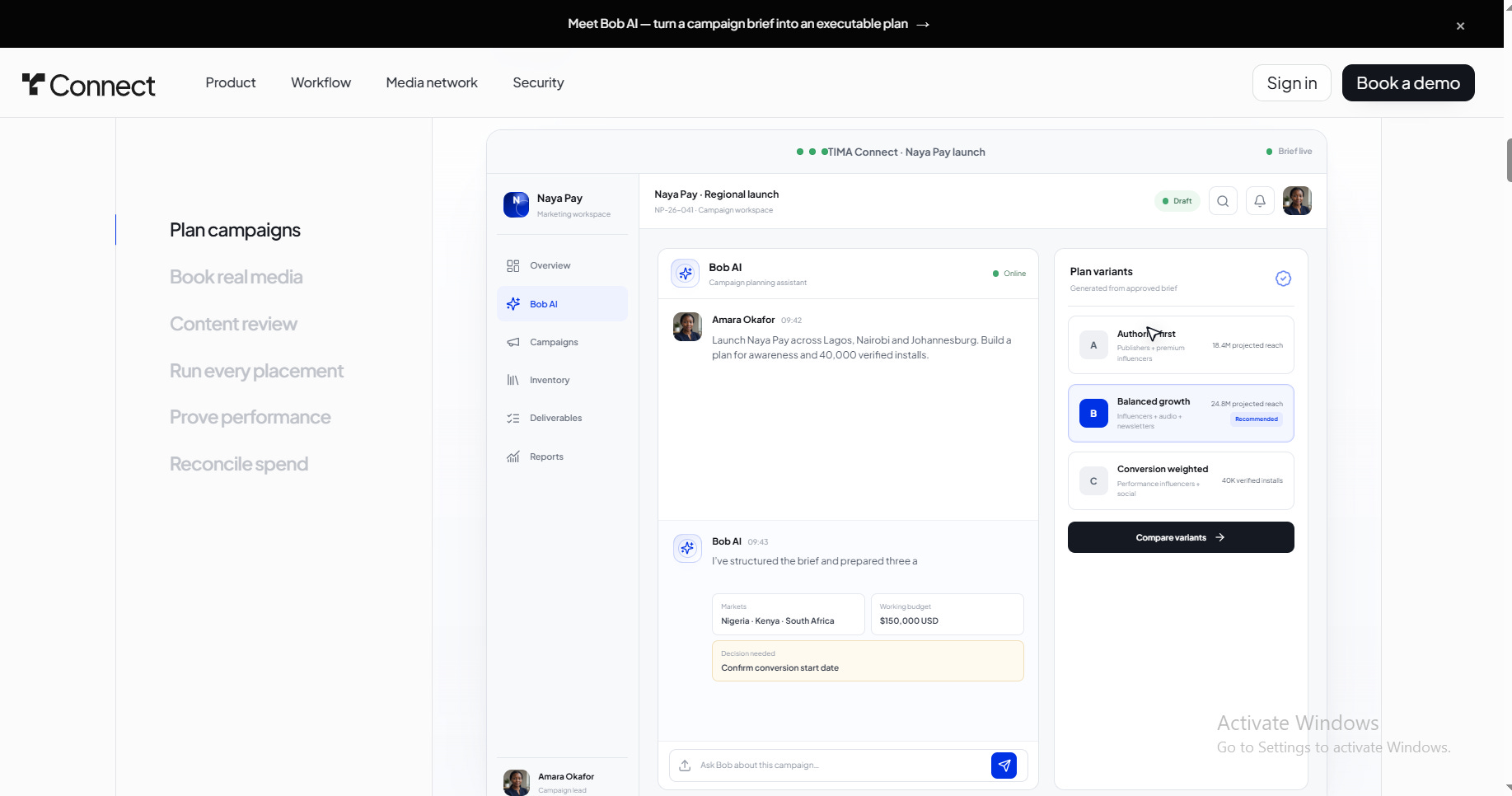
TIMA Connect is an AI-native media intelligence and buying platform for Africa and the Middle East.
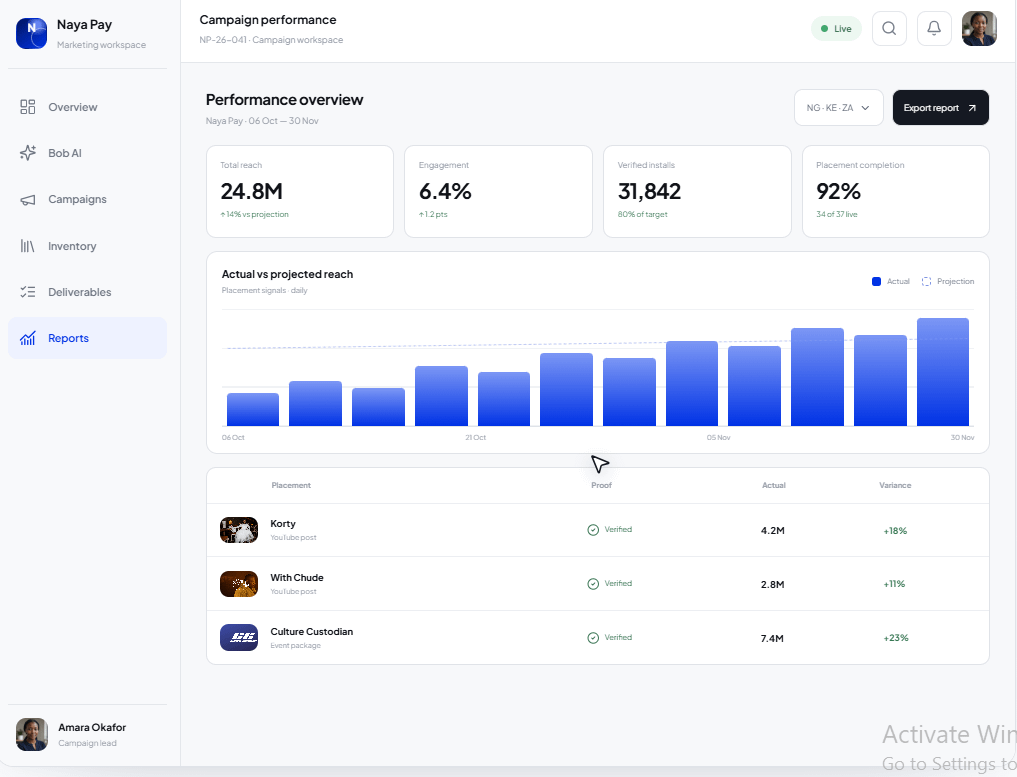
One workspace covering influencers, podcasts, newsletters, publications, shows, films, and social. AI-assisted campaign planning, publisher inventory, deliverables, and placement performance tracked together. Reach, engagement, and completion signals per placement, with campaign reporting exports in CSV, XLSX, and PDF.
It was built by TIMA, an agency across Nigeria, South Africa, Kenya, Ghana, Botswana, and Cameroon that has spent years inside the actual friction points of African influencer marketing.
That last detail is the one that matters.
TIMA Connect is not a Silicon Valley product team that looked at Africa’s creator economy data and decided there was a market opportunity. It is infrastructure built by people who have had to stitch together the spreadsheets, navigate the payment fragmentation, and deliver unified campaign reports to clients across formats that were never designed to talk to each other.
The knowledge embedded in the platform is operational, not theoretical. That distinction is what makes the ownership argument defensible rather than rhetorical.
What This Signals for the Industry
Brands that cannot plan, buy, and measure African creator campaigns efficiently spend less on those campaigns.
They default to platforms with better reporting infrastructure, which typically means Western platforms, which means the money does not reach African creators at the scale the market should be generating. Better measurement infrastructure makes the internal business case for African creator campaigns easier to make. It reduces the friction between a brand’s marketing team wanting to run an African creator campaign and the finance team demanding evidence that it will perform.
That is not a small thing.
Africa’s creator economy is projected to keep growing through 2030, driven by a young, mobile-first population creating and consuming content across formats that Western measurement infrastructure was not built to track. The platform that builds the trusted system of record for that activity is not building a niche product. It is building foundational infrastructure for a market that global platforms have consistently underserved.
TIMA Connect is one signal that the African creative economy is starting to build its own answers instead of waiting for global platforms to eventually prioritise it.
That shift, from waiting to building, is the one that will determine whether Africa’s creator economy captures the economic value of its own output or continues to generate it for infrastructure owned elsewhere.
Where to Go From Here
If you are a brand planning campaigns in African markets, TIMA Connect is worth a look. Not as a replacement for strategic thinking but as the infrastructure that makes executing that thinking measurably less painful.
If you are watching where African creative infrastructure is being built and by whom, this is the layer of the market that has been an afterthought for long enough.
Explore TIMA Connect at timaconnect.ai.

Written by Layo
Lead Editorial Writer, Creative Brief Africa
Outside of her editorial work, she writes Curious Health, a newsletter focused on everyday health questions, explored with clarity and care.