


The global animation industry is no longer a niche corner of entertainment. According to Precedence Research, the market is valued at $462.32 billion in 2025, projected to hit $492.14 billion in 2026, and on pace to nearly double to $953.31 billion by 2035 — a compound annual growth rate of 7.52%. Some forecasts run even higher, with one analysis projecting $956.53 billion by 2035 at a similar growth rate.
Whichever number you trust, the direction is unmistakable. Animation has quietly become one of the fastest-growing segments of the global content economy, and the forces driving it are structural, not cyclical: an insatiable streaming appetite, the rise of real-time gaming engines, and mobile-first consumption habits that favor short-form, visually dense content over almost anything else.
For Africa, this growth curve is not background noise. It is the most significant opportunity the continent’s creative industries have been handed in a decade — and the most significant test of whether African studios can graduate from service work to ownership.
Why the Number Is Growing So Fast
Three forces are doing most of the work.
Streaming has changed who commissions animation
Netflix’s animation strategy is the clearest proof point: large-scale investment in animated content driving audience engagement, global expansion, and sustained subscriber growth. Disney+, Amazon Prime, and Hulu have followed the same playbook. Animation is cheaper to localize than live action, ages better across markets, and travels across language barriers more easily than dialogue-heavy drama. Streamers have figured out that animated content is a retention engine, not a kids’-programming afterthought.
Real-time engines have rewritten production economics
Tools built originally for video games — Unreal Engine, Unity — are now standard in animation and VFX pipelines. They collapse render times, enable virtual production, and make high-end visual quality achievable at a fraction of the cost and timeline of traditional rendering. This is part of why the broader Animation and VFX market is projected to reach $386 billion by 2031, growing faster than animation alone.
Mobile consumption rewards animation’s core strength
Animation was built for the small screen before the small screen existed — bold colors, exaggerated motion, high visual clarity at low resolution. As gaming and short-form video become primarily mobile experiences, animation’s native visual language is winning by default. The global gaming market alone is projected to hit $408 billion in 2026 en route to $1.09 trillion by 2034, and animation is structurally embedded inside that growth, not adjacent to it.
Layer onto this the rise of generative AI tools, which grew from a $2.37 billion market in 2025 to an estimated $3.23 billion in 2026 — automating tasks like in-betweening and character rigging that have historically consumed 60–70% of production schedules. That shift frees studios to spend more time on IP development and less on repetitive labor. It is, in theory, exactly the kind of efficiency gain that should help under-resourced studios compete.
Where Africa Actually Stands
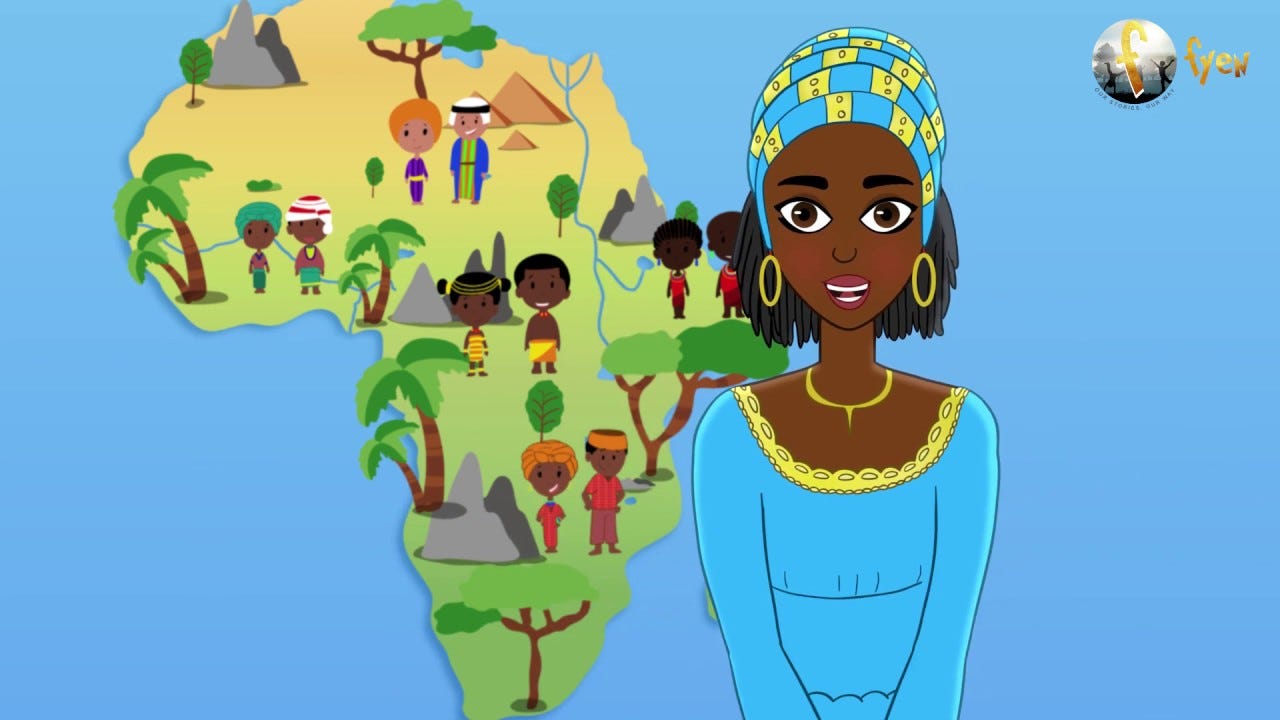
The African animation market itself is far smaller than the global figure, but its trajectory is genuinely encouraging: from $12.3 billion in 2022 to $14.52 billion in 2024, with a projected $15.71 billion in 2025. That is real, compounding growth — and it has come with unmistakable creative credibility.
South Africa’s Triggerfish Animation Studios, widely regarded as the continent’s most influential animation house, has built relationships with Disney, Netflix, BBC, Lucasfilm, and Sony Pictures Animation. Its pan-African anthology Kizazi Moto: Generation Fire drew animators from Zimbabwe, South Africa, Uganda, Nigeria, Kenya, and Egypt, earned multiple Emmy nominations, and proved that African studios could run productions at a scale and quality bar that satisfies the biggest commissioners in the world.
Nigeria’s Kugali Media did something arguably more significant: it became the first external studio to produce an original long-form Disney+ series — Iwájú, a Lagos-set science fiction story that earned three Emmy nominations and a seven-book publishing deal with Disney Hyperion. Roye Okupe’s Iyanu, rooted in Yoruba mythology, premiered on Cartoon Network and HBO Max in 2025 and was renewed for a second season alongside two feature films. Tanzania’s Ubongo reaches over 11 million children weekly with educational animated content across nine countries — proof that African animation’s commercial potential extends well beyond entertainment into edtech.
These are not isolated wins. They are evidence that African animation has crossed a credibility threshold with the platforms that control global distribution.
The Catch: Service Work Versus Ownership
Here is where the optimism needs a harder edge.
As Stuart Forrest, Triggerfish’s CEO, has pointed out, most African audiences have still never heard of African animated shows outside of the handful that break through via Kugali or Disney partnerships. The industry, in his words, is “really in its infancy” — even as international accolades pile up.
The deeper structural issue is financial. Animation production in Kenya and Nigeria costs roughly $6,000–$8,000 per minute. In South Africa, costs climb closer to $12,000–$14,000 per minute, approaching European standards. Triggerfish itself, despite being the continent’s flagship studio, had to open offices in Ireland and the UK to access tax rebates, co-production treaties, and funding schemes unavailable on the continent. France offers a 30% production tax rebate. Saudi Arabia offers 40%. Mauritius offers up to 50%. No major African production hub currently offers anything comparable, which means African IP is often financed, banked, and partly owned through foreign entities by necessity, not preference.
This pushes many studios toward what the industry calls “prestige service work” — high-quality outsourced production for international clients, used to stabilize cash flow while studios slowly fund their own original IP. It is a legitimate survival strategy. Triggerfish’s video game co-development arm, Balisti Studios, generates revenue precisely this way. But it also means a meaningful share of African animation talent and labor hours are spent building someone else’s intellectual property rather than the continent’s own.
The distribution problem compounds this. Independent African animated shows reaching audiences directly via YouTube — Kenya’s Super Sema, Nigeria’s Omo Berry, Uganda’s Kunda & Friends — have built genuine subscriber bases in the hundreds of thousands to over a million. But monetizing those audiences runs into the same CPM disparity that constrains every other African content category: advertisers pay less for African viewership than American or European viewership, regardless of audience size or engagement quality.
What This Means for the Decade Ahead
The global animation market’s run toward $953 billion is not a forecast African creators should watch from the sidelines. The underlying demand drivers — streaming appetite, real-time engines, mobile-first consumption — map almost perfectly onto conditions already present across the continent: young populations, mobile-dominant internet access, and a storytelling tradition deep enough to supply a decade of original IP without repeating a single myth.
What is missing is not talent or ambition. It is the financial infrastructure — tax incentives, production financing, IP-retention deal structures — that turns service work into ownership. Triggerfish, Kugali, Ubongo, and a growing list of smaller studios have already proven the creative case. The economic case is still being built, deal by deal, rebate by rebate, often outside the continent’s own borders.
The global animation boom is coming regardless. The only open question is how much of that nearly trillion-dollar market Africa ends up owning, versus how much of it Africa simply renders for somebody else.

Written by Layo
Lead Editorial Writer, Creative Brief Africa
Outside of her editorial work, she writes Curious Health, a newsletter focused on everyday health questions, explored with clarity and care.