


Here is what the math looks like for a mid-tier African creator in 2026.
Strong audience. Real cultural trust. Followers who actually buy things because this creator told them to. A brand contacts them. A rate gets negotiated. Content goes up. The brand checks likes. Payment arrives, eventually. Then silence. Then another brand. Another negotiation from scratch. Another post with no relationship on either side of it.
This is not how a media channel works.
This is how a favour works.
And Africa’s $4.3 billion digital advertising market is still treating its most culturally connected channel like a favour economy.
The Gap Is Bigger Than It Looks
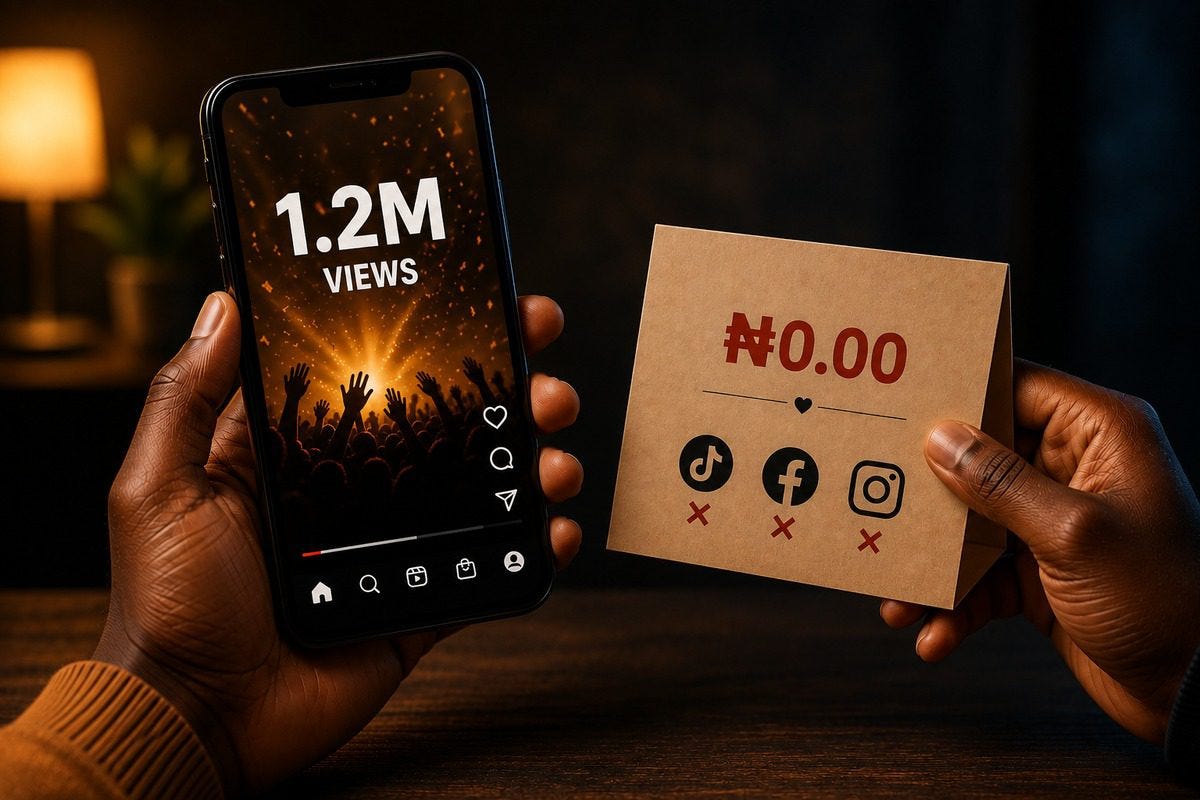
Africa’s digital advertising market is worth $4.3 billion in 2026, confirmed by the Research and Markets Q1 2026 Databook. It is growing at 12.5% annually, heading toward $6.5 billion by 2029. Social media is where the attention lives. More than 65% of young Nigerians have purchased something because a creator recommended it, according to GeoPoll and NOI Polls data. The attention is real. The commercial influence is documented.
Influencer marketing, the channel that runs directly on that attention, accounts for an estimated 4.1% of that $4.3 billion. That figure is derived from available market data rather than a single published source and should be read as an estimate. But the direction is not in dispute. Industry analysis puts Nigerian influencer spend at under 2% of total digital ad spend in the country. Across the continent, the picture does not improve significantly.
A channel that reaches audiences with more directness and more trust than most programmatic alternatives is capturing less than one in twenty dollars of the continent’s digital advertising budget.
That gap does not exist because creators are not good enough.
It exists because the commercial infrastructure around them is not built.
What the Rest of the World Has Already Figured Out
The Digiday 2026 Media Agency Report surveyed agency professionals in Q3 2026. 75% said creator marketing has become significantly more important to their business over the past year. More telling than the headline is what is happening underneath it.
Globally, influencer marketing is being institutionalised. Creators are entering annual marketing plans. Retainers are replacing per-post deals. CFOs are auditing creator spend with the same rigour applied to search and programmatic. Brands are asking creators to produce content that sits inside long-term commercial strategies rather than isolated campaigns that run once and disappear.
The global influencer marketing industry is valued at $47.8 billion in 2026. That number grew because brands stopped treating creators like an ad channel they could dip into and started treating them like media assets worth long-term relationships.
African creator deals are still operating on the opposite logic.
The question is not whether the global shift is happening. It clearly is. The question is whether Africa’s creator market develops the infrastructure to participate in it, or watches the gap between local practice and global standard widen for another decade.
The Real Cost of Per-Post Culture
The per-post structure is not just a pricing problem. It is a valuation problem.
When a brand buys a post, it is buying a unit of attention that exists in isolation. The post runs. The brand checks vanity metrics. The creator gets paid. The relationship ends. There is no mechanism for the brand to know whether the campaign actually moved anything. There is no mechanism for the creator to prove it did. There is no data that accumulates into a case for a bigger investment next time.
The DottsMediaHouse fourth Nigeria Influencer Marketing Report documented cumulative influencer spend of ₦161.4 billion between 2021 and 2025, with a projected ₦58.9 billion in 2025 alone. That is a significant amount of money moving through a channel with almost no measurement infrastructure underneath it. Brands are spending. They simply cannot tell you what they got for it.
For creators, the consequence is concrete.
Every negotiation starts from zero. There is no performance track record that travels from one brand relationship to the next. No data that says: here is what I delivered last time, here is what I am worth, here is why you should pay me more. Influence gets priced on name recognition at the top of the market and on gut feel everywhere below it. Name recognition is not infrastructure. It is a workaround for the absence of measurement. Every creator who is not already famous is absorbing that uncertainty in their rate.
The Missing Language
The biggest challenge in Africa’s influencer marketing market is not reach. It is not content quality. It is not even pricing, though pricing is where the problem becomes visible.
It is measurement.
Tiwalola Olanubi, chief publisher of the Nigeria Influencer Marketing Report, named it plainly: “The biggest challenge remains accurate measurement and trust. Many brands still struggle to quantify the ROI from influencer campaigns. Traditional marketing metrics do not always capture the full value of influence, especially when the impact happens over time.”
The Nigeria Influencer Marketing Report has been making this argument since its first edition in 2019.
It is 2026 and measurement is still the lead problem.
That is not a coincidence. It is the natural result of a market where every stakeholder has adapted to the absence of a standard rather than building one. Brands learned to check follower count and move on. Agencies learned to bundle creator fees into campaign costs that clients cannot audit. Creators learned to negotiate on relationships because there is no data currency to negotiate on.
What is missing is a shared language. A unit of measurement that means the same thing to a creator pitching their audience, a brand evaluating the pitch, and a CFO approving the budget. Without that language, influencer marketing in Africa will keep being treated as experimental spend rather than planned media. It will keep sitting at under 5% of digital ad spend, not because the audiences are not there, but because the infrastructure to justify more simply does not exist.
Who Moves First
Three candidates. Three problems.
Agencies could build the standard. They have client relationships and budget visibility to set terms. The conflict of interest is structural. When no measurement standard exists, agencies control the terms of every deal. When a standard exists, clients can audit against it. The industry body that benefits from opacity is not the most reliable architect of transparency.
Platforms could build it. The major social platforms have the data. They also have the most to gain from ad spend flowing through their own infrastructure, which means the metrics they publish are optimised for platform engagement rather than business outcomes. A brand trying to compare a creator campaign to a programmatic display buy cannot use a social platform’s native dashboard to do it.
A neutral body is the only option that does not carry a structural conflict of interest. An industry coalition with representation from agencies, brands, and creators that establishes common reporting standards, audience verification frameworks, and performance attribution models for African influencer marketing. Every ingredient exists. The trade associations are there. The agency networks are there. The brand community is there. What has not happened is the decision to sit in the same room long enough to produce something binding.
The Nigeria Influencer Marketing Report has been calling for stronger measurement frameworks since 2019.
Somebody needs to actually build them.
What Changes When the Gap Closes
This is not a policy question. It is a creator income question.
A creator who moves from per-post deals to a structured retainer relationship does not just earn more on that contract. They earn differently. Predictable income allows investment. Investment builds production quality, team depth, and content strategy that compounds. Compounding builds the track record that justifies larger deals. Larger deals attract better partners. The whole system starts moving upward instead of resetting to zero after every campaign.
The global trajectory is already moving this way. Brands are deepening creator relationships. Creators are entering core budgets. The measurement infrastructure that makes this possible is being built in markets where it pays to build it.
Africa’s creator market is large enough to deserve the same. The audience trust is documented. The commercial influence is real. The cumulative spend figures from Nigeria alone make the market size undeniable.
The 4% figure is not a ceiling.
It is the cost of operating without infrastructure.
The distance between 4% and what this channel should command is not technical. It is political. It is the distance between a market that has decided measurement matters enough to build a standard and one that has not.
Until someone makes that decision, Africa’s creators will keep receiving one in twenty dollars of the attention budget they are actually driving.

Written by Layo
Lead Editorial Writer, Creative Brief Africa
Outside of her editorial work, she writes Curious Health, a newsletter focused on everyday health questions, explored with clarity and care.