

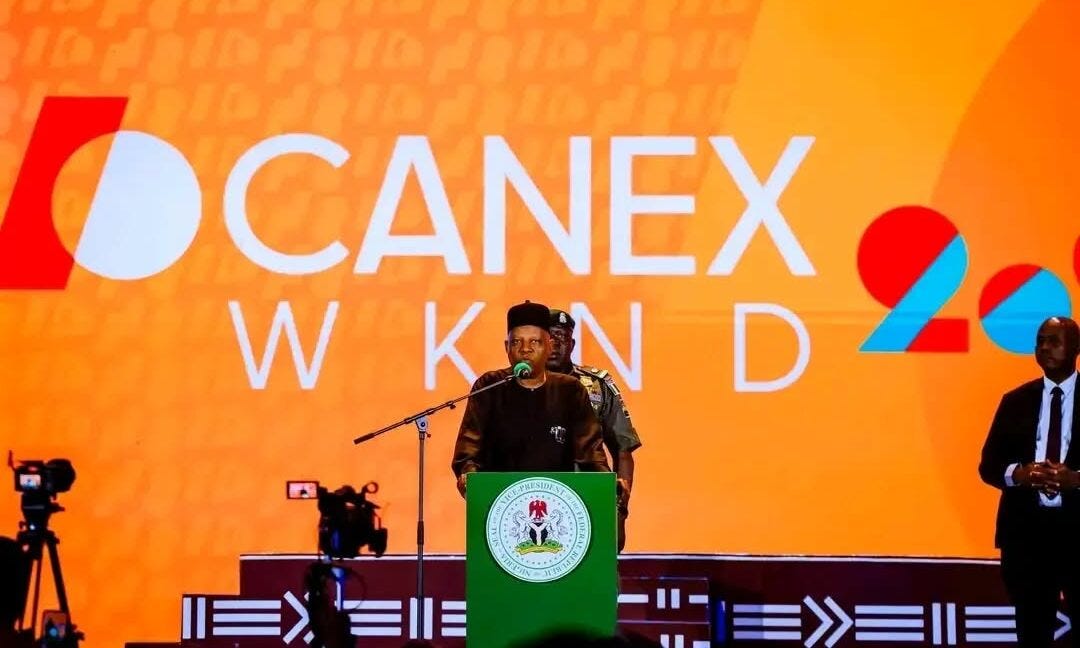
“In 1977, we came to celebrate our culture. In 2026, we come to capitalise on it.”
Vice President Kashim Shettima said that at the opening of CANEX WKND 2026 in Lagos, speaking on behalf of President Tinubu. The line works because of the dates. In 1977, Lagos hosted FESTAC, the great festival of Black and African arts. Nearly fifty years later, the city hosted Afreximbank’s flagship creative-economy weekend, and this year’s theme links the two: “From FESTAC ‘77 to CANEX ‘27.”
Here is what the week put on the table, and why it matters for anyone who makes things for a living.
The money, in plain numbers
Afreximbank launched its creative-industries support in 2020 with a $500 million commitment. It rose to $1 billion in 2022. At CANEX WKND 2024 in Algiers, then-president Benedict Oramah doubled it again to $2 billion for the following three years. That figure was restated in Lagos, now through 2027. The Algiers edition reported more than $540 million in trade and investment deals facilitated, with participants from 81 countries.
The $2 billion is not only film cash. It covers production infrastructure such as studios, music arenas and fashion hubs, training for creative professionals, and a $500 million private equity film fund through Afreximbank’s impact equity arm.
Then there is the package announced in Lagos. It totals $118 million and has three parts:
A $75 million facility between Afreximbank and the Development Bank of Nigeria.
A $30 million arrangement involving the Nigerian Export-Import Bank, the Small and Medium Enterprises Development Agency and Afreximbank.
A $13 million grant from the same three.
That $30 million is separate from the one AFD signed with the Bank of Industry on October 28.
Who the institutions are
The names matter, because they show how money reaches a creative business.
The Development Bank of Nigeria does not lend to most businesses directly. It provides wholesale funding and risk-sharing to commercial banks, microfinance banks and other lenders, which then on-lend to small businesses. NEXIM is Nigeria’s export credit agency, set up in 1991 to finance non-oil exports. SMEDAN is the government’s main agency for small and medium enterprises. NEXIM and SMEDAN signed a partnership in July 2025 focused on export funding, training and simplified export processes.
Read together, the pattern is clear. The money is moving through channels built for small businesses and exporters, and the creative sector is being plugged into them. For most designers and producers, the route to this capital is likely to run through a lender or an agency, not directly through Afreximbank.
The argument from the stage
The most useful speech of the opening came from Afreximbank’s current president, George Elombi.
“We can put these financing schemes into music and movie productions,” he said. “Yet the value we derive will still be low.”
His point was about ownership. Financing production alone does not change who captures the value, because the profit sits in rights, distribution and the supply chain around the work. Elombi put Africa’s creative economy at about $60 billion, roughly 2 percent of the global industry, citing the UN Economic Commission for Africa. A small share of the world’s market, he argued, is partly a product of how little of the value stays on the continent.
That is a candid thing for a lender to say about its own product. It also sets the standard to hold the next announcement to. Money for production is welcome. Money that helps creators keep their rights is the measure that matters.
What Nigeria brought
Nigeria came with more than a venue. The country approved its first National Intellectual Property Policy and Strategy in 2025 and launched a Creative Sector Investment Playbook in January 2026, aimed at studios, content production and distribution. According to Afreximbank’s release, iDICE, the federal programme run through the Bank of Industry, is unlocking more than $600 million for digital and creative enterprises.
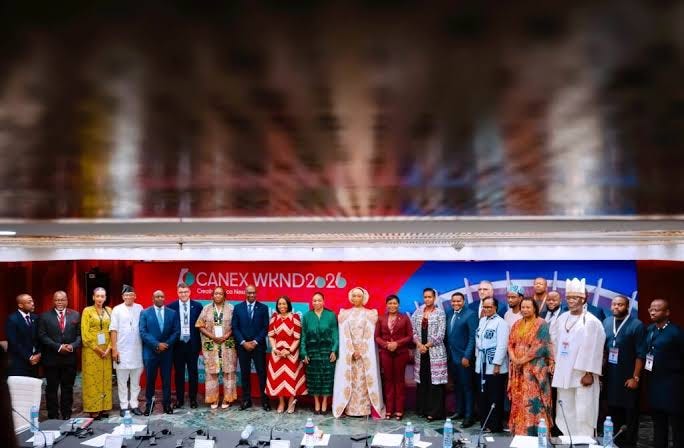
Trade Minister Jumoke Oduwole gave the line that defined the week for the government side: “We promised to bring buyers and investors here. Today, Nigerian creatives are negotiating with them in Lagos.” Proposed transactions worth more than $500 million were being discussed in deal rooms co-curated with Afreximbank, spanning sports, gaming, creative technology, infrastructure, arts and gastronomy.
Beyond the boardroom
The programme was wide. More than 15,000 delegates were expected, from across Africa, the Caribbean and the diaspora. The Deal Room and Creative Pitch Sessions put creators in front of financiers. A Creative Economy Finance Summit covered how to structure creative-sector deals, and an African Producer Accelerator worked with producers. A high-level panel on November 6 was set to bring Nobel laureate Wole Soyinka together with culture ministers from Côte d’Ivoire, South Africa and Rwanda.
The culture strand kept the event human. A concert on November 7 was announced with Davido, Fally Ipupa, Flavour, Libianca and Charlotte Dipanda. The CANEX Prize for Publishing offered $20,000 to the winning publisher of the best trade book of 2025. A CreaThon with Gebeya put a $50,000 prize pool behind music, video and game projects. The Music Factory songwriting camp and a Legends football match at Onikan were set for Sunday.
Fashion had its own place too, with the CANEX Fashion Show and Awards Night on the Friday. Lagos Fashion Week, a week earlier, gave designers an audience. CANEX is where they could meet a counterparty.
What to carry forward
For creators, three things follow from the week.
First, the institutions to know are the Development Bank of Nigeria, NEXIM and SMEDAN. They are where the $118 million flows.
Second, ownership is now part of the conversation at the top. If a lender is saying that production finance leaves value low, creators can ask for terms that protect their rights.
Third, the next stage is already named. IATF 2027, also in Lagos, carries a federal target of more than $50 billion in deals. When the CANEX WKND organisers publish their results, the figures worth looking for are how much of the pledge has been disbursed, how many creative businesses received it, and what share of the value stays with the people who made the work.

Written by Layo
Lead Editorial Writer, Creative Brief Africa
Outside of her editorial work, she writes Curious Health, a newsletter focused on everyday health questions, explored with clarity and care.