


Africa does not have a shortage of events about the creative economy.
ACM 2026 just wrapped six days in Lusaka. The Ghana Creative Economy Initiative ran ten days in Accra in July. MAFA is launching in Abidjan in November. FESPACO runs biennially in Ouagadougou. Cannes has its Marché du Film. Every city with creative economy ambitions has a summit, a festival, or a forum attached to it now.
The question is not whether Entertainment Week Africa deserves to exist.
It has earned its place. Four editions, 67,800 cumulative attendees, and enough institutional momentum that the British High Commission, the US Embassy, Netflix, Amazon Prime, Showmax, and Chocolate City have all shown up as partners.
The question is what its fifth edition actually does with that position.
What EWA Has Already Built
It started in 2022 as Entertainment Week Lagos.
Eight days. A foundational platform. An idea that Lagos needed a dedicated space where creative industry stakeholders could gather, not just to celebrate output, but to talk about the business underneath it.
The second edition followed in December 2023 at the Livespot Entertarium. The third expanded into a multi-format industry experience. By 2025, the event had rebranded into Entertainment Week Africa and grown into something measurably different from a conference.
The 2025 edition drew 28,683 pass-holders from 8+ countries and 50+ industries across 61 sessions, 93 film screenings, 20 music showcases, and 9 fashion showcases, generating 5 million online engagements and 800 million digital reach and impressions across Africa, Asia, North America, and Europe.
Those are real numbers. They represent a platform that has scaled beyond Lagos and beyond Nigeria in meaningful ways. The venue spread across Livespot Entertarium, Eko Hotel, EbonyLife Place, and Alliance Française. The sponsors included Heineken, Pepsi, MTN, and TikTok alongside the diplomatic missions and media organisations.
But the number that matters most from 2025 is smaller and more specific.
The EWA Deal Room received 178 entries. Nine companies advanced to the accelerator programme. Four companies, Aktivate, FriendnPal, Growwr, and Sports Reels, attracted live investor interest in the room. Investors connected to the Deal Room and Hackathon included Future Africa, Catalyst Fund, Consonance Invest, and Askya Investment Partners.
That is the number that separates EWA from an industry celebration. Four companies in front of live investors, in a room built specifically for that transaction. It is a small number relative to the 178 entries. But it is proof that the mechanism works.
What “Five Years of Closing the Gap” Actually Means
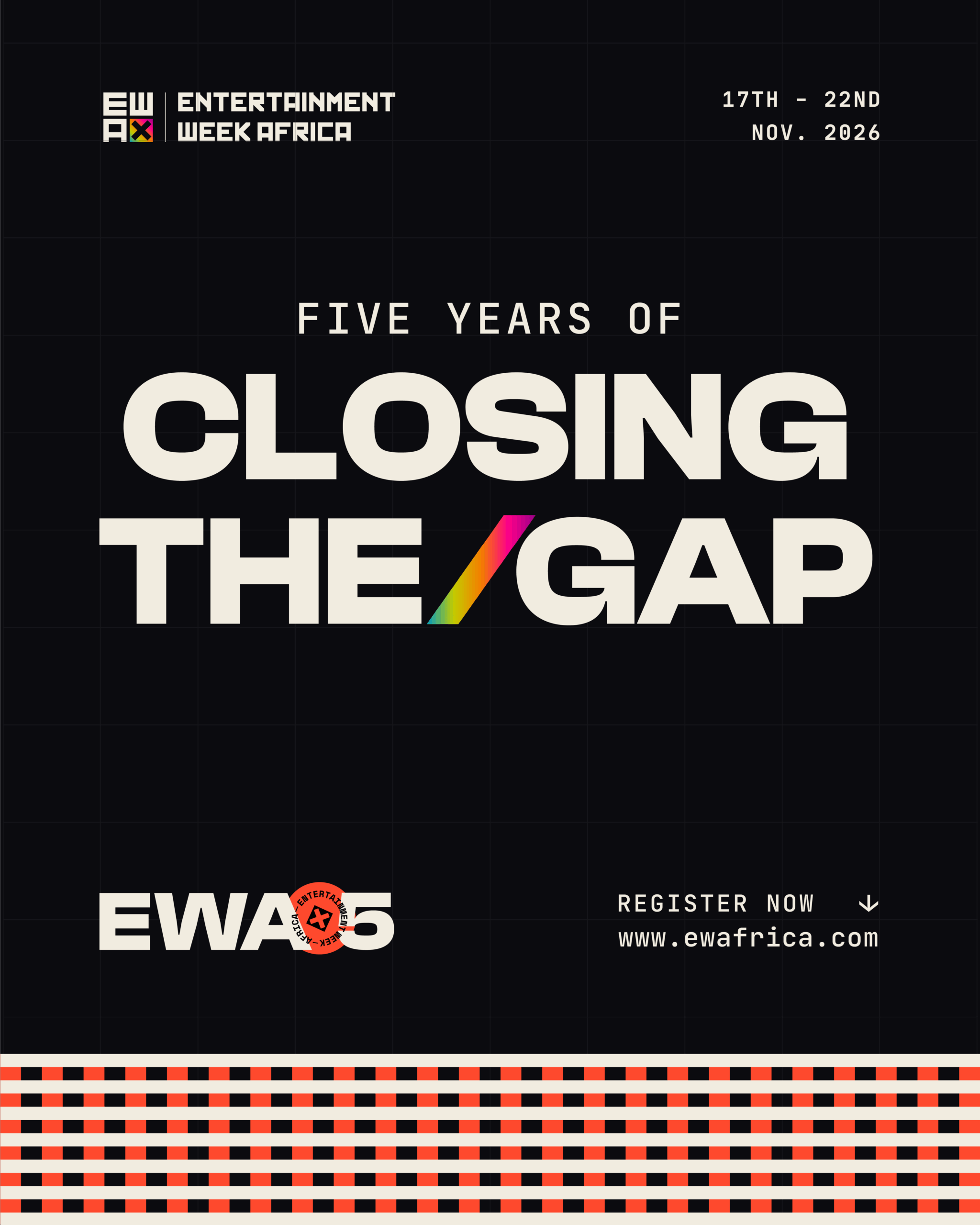
EWA 2026 runs November 17 to 22 in Lagos under the theme Five Years of Closing the Gap.
The phrasing is deliberate. The gap in question is the one the African creative economy talks about constantly and solves for inconsistently: the distance between cultural visibility and economic value. Between having a story and owning the rights to it. Between being on a global streaming platform and capturing a meaningful share of what that generates.
The 2026 edition covers seven tracks. Film and TV. Music. Fashion and Beauty. AI and Tech. Art and Animation. Live Events and Production. Creative Enterprise.
Each track, according to the organisers, is designed not only as a content programme but as a platform for practical outcomes. Pitch opportunities. Closed-door industry sessions. Talent development. Market access. Post-event follow-through.
The Fashion and Beauty track is the clearest example of how the evolution from showcase to market is being executed. The 2025 EWA Runway Coterie received over 120 entries and put ten emerging designers on a stage that reached 28,683 attendees. In 2026, EWA expands that platform into a more structured commercial environment, connecting African designers with buyers, brand partners, press, and the commercial infrastructure that turns runway moments into lasting businesses.
That sentence is the whole argument in one line. Runway moments into lasting businesses.
The addition that signals EWA’s own evolution most directly is Livespot Studios producing its first scripted feature film. University of Side Hustle, written by Dami Elebe and executive produced by Deola Art-Alade, will world premiere at the 2026 edition. The event that started by convening the industry is now producing the IP the industry exports.
The International Dimension
EWA has been quietly extending its reach through EWA Creative Connect, an invitation-only convening series that takes the platform beyond Lagos.
Creative Connect launched in Los Angeles during Grammy Week 2026, convening senior executives from Warner Records, Adobe, Amazon, Dramabox, Afreximbank, and Unilever.
That guest list is worth reading carefully. Warner Records. Amazon. Adobe. These are not organisations attending an African creative economy conference for optics. They are organisations whose business decisions affect the terms on which African creators and companies operate globally. Getting those decision-makers into a room in Los Angeles during Grammy Week, on African creative economy terms, is a different kind of positioning than hosting a Lagos conference and inviting global brands to attend.
It suggests that EWA 2026 in November is not meant to be the only point of contact with the global industry. It is meant to be the centrepiece of a year-round programme of relationship-building that the November event can then convert into tangible outcomes.
What the Fifth Edition Has to Prove
Here is the honest version of what the fifth anniversary needs to deliver.
Africa’s creative economy is in a very different moment than it was when EWA launched in 2022. The infrastructure investment wave is visible and accelerating. Afreximbank has committed $1 billion to African film. MAFA is building Africa’s first animation market. The Ghana Creative Economy Initiative is professionalising African film talent with Hollywood practitioners in the room. ACM 2026 in Lusaka drew government officials and policymakers alongside creatives and investors, and explicitly named IP protection, cross-border licensing, and AfCFTA as priority instruments.
The continent is building faster now. And the events that thrive in this environment will be the ones that function as markets, not just mirrors.
EWA has the foundation. Four editions. 67,800 attendees. A Deal Room that produced live investor interest. International relationships that extend to Los Angeles and beyond. A theme, Five Years of Closing the Gap, that names the right problem.
The 2026 edition’s job is to close it.
Not for all 28,000 attendees. The infrastructure investment wave is not a mass participation event. It is a pipeline. The right deals happen between the right people in the right rooms. EWA’s job is to build those rooms with enough intentionality that the people who should be in them actually show up, actually talk, and actually leave with something more than a panel recording and a lanyard.
The Deal Room is where that happens. The Runway Coterie evolving into a commercial market environment is where that happens. The Creative Enterprise track is where that happens.
The sessions, the screenings, the showcases, and the premieres are the reason people come.
The deals are the reason the event matters.

Written by Layo
Lead Editorial Writer, Creative Brief Africa
Outside of her editorial work, she writes Curious Health, a newsletter focused on everyday health questions, explored with clarity and care.