


Africa does not control the global fashion system. But it absorbs its consequences.
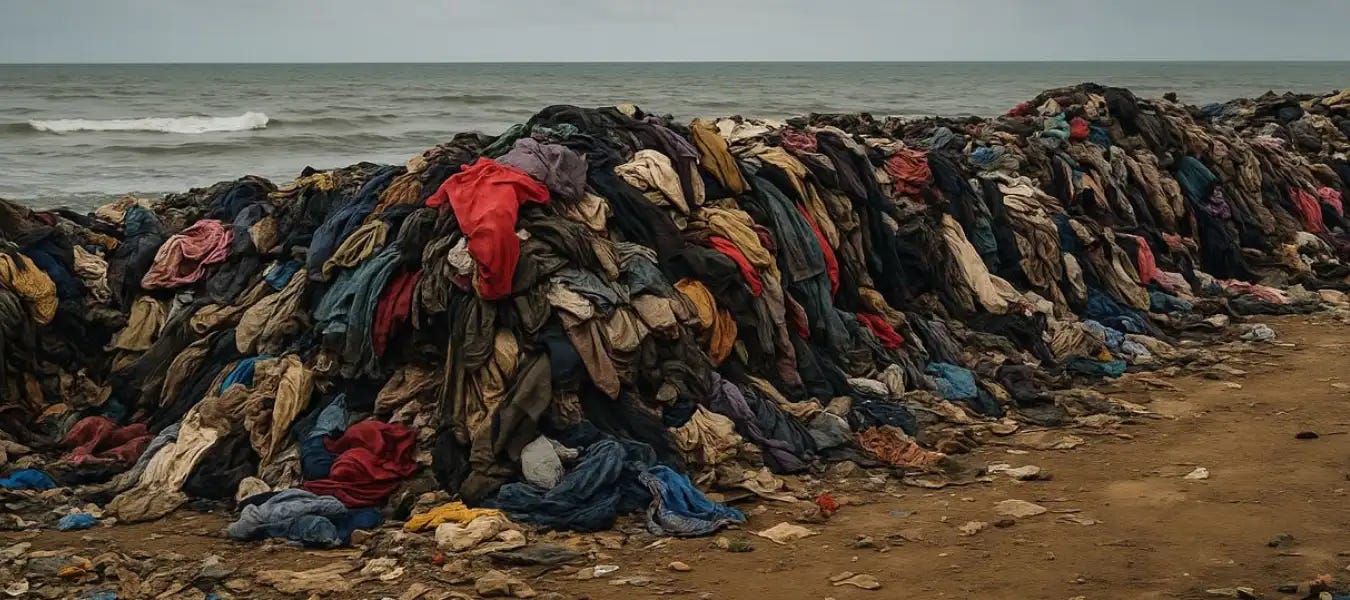
Every year, millions of tons of second-hand garments arrive on the continent, much of it unsellable, much of it waste. Markets overflow. Landfills expand. Informal recyclers improvise. The surplus was not produced in Accra, Nairobi, or Addis Ababa. It was produced elsewhere.
Africa is downstream in fashion’s waste chain.
The real question is not whether the continent should industrialise in textiles and apparel. It is whether it can industrialise differently.
The False Choice: Jobs or Sustainability
Textiles and apparel have historically been the entry point into industrialisation. From East Asia to Latin America, garment manufacturing created formal jobs, particularly for women, built export capacity, and catalysed broader industrial ecosystems.
Africa needs jobs at scale. It needs value addition. It needs export revenue.
But global fashion’s dominant model is built on overproduction. Ultra-fast inventory cycles. Discounting as a structural feature. Externalised environmental costs. When supply chains overshoot demand, surplus travels south. Markets such as Kantamanto in Ghana receive the overflow of a system they did not design.
The debate is often framed as a contradiction: industrialise and risk replicating a polluting model, or remain environmentally pure but economically marginal.
That framing is flawed.
The choice is not between industrialisation and sustainability. The choice is between copying and designing.
Fashion and Textile Are One System
One structural problem lies in how the sector is categorised.
Textiles are treated as “industry.” Fashion is treated as “creativity.” In many governments, textile policy sits under manufacturing or trade ministries. Fashion sits under culture.
But cotton, fibre, fabric, garment, brand, retail, and waste are not separate industries. They are one value chain.
When textile factories are built without strong domestic or regional brands, capacity sits idle. When fashion brands grow without manufacturing depth, margins are squeezed and scale is constrained. When waste systems are ignored, the environmental bill accumulates downstream.
Fragmented policy produces fragmented capital allocation. Industrial parks are financed as infrastructure plays. Fashion SMEs are funded, if at all, as small creative ventures. Environmental upgrades are treated as compliance burdens rather than strategic assets.
Reframing fashion and textiles as one integrated asset class changes the equation. It makes sustainability a systems question, not a moral add-on.
Africa’s Late-Mover Advantage
There is a paradox at play.
Africa is late to large-scale textile industrialisation relative to Asia. But being late can be an advantage.
The continent does not carry decades of sunk investment in coal-powered factories or outdated dyeing systems. It does not have entrenched overcapacity tied to hyper-accelerated consumption cycles. It has room to design clusters differently from the outset.
In Ethiopia, industrial cluster models supported by actors such as GIZ have experimented with wastewater treatment systems, water use reductions, renewable energy integration, and labour standards embedded at park level rather than retrofitted factory by factory. Cluster-level environmental design lowers compliance costs and raises baseline standards.
This matters because global buyers are recalibrating. European due diligence regulations, carbon border mechanisms, and traceability requirements are tightening. Brands are under pressure to decarbonise supply chains and demonstrate ethical sourcing.
If African textile hubs embed environmental performance early, they can compete not on lowest labour cost, but on cleaner production and traceable value chains.
Sustainability shifts from being a defensive posture to a competitive lever.
Domestic Demand as Industrial Anchor
Industrialisation without demand is fragile.
One of the most consistent lessons across emerging markets is that domestic and regional consumption stabilises production cycles. Export-only models expose factories to volatile global demand and buyer consolidation.
In East Africa, companies such as Vivo Fashion Group illustrate a hybrid pathway. The company built scale by producing locally while serving domestic consumers across 30 plus stores in the region. Roughly 450 employees, mostly women, are part of that ecosystem.
This is not fast fashion in the Western sense. It is responsive manufacturing anchored in local demand patterns.
Industrialisation rooted in domestic consumption allows more calibrated production volumes. It reduces the pressure to chase unrealistic export surges. It supports employment without structurally committing to overproduction.
Africa’s population growth and urbanisation create a large future consumer base. The strategic question is whether that demand will be met by imported surplus or by local, cleaner manufacturing.
Waste as Signal, Not Destiny
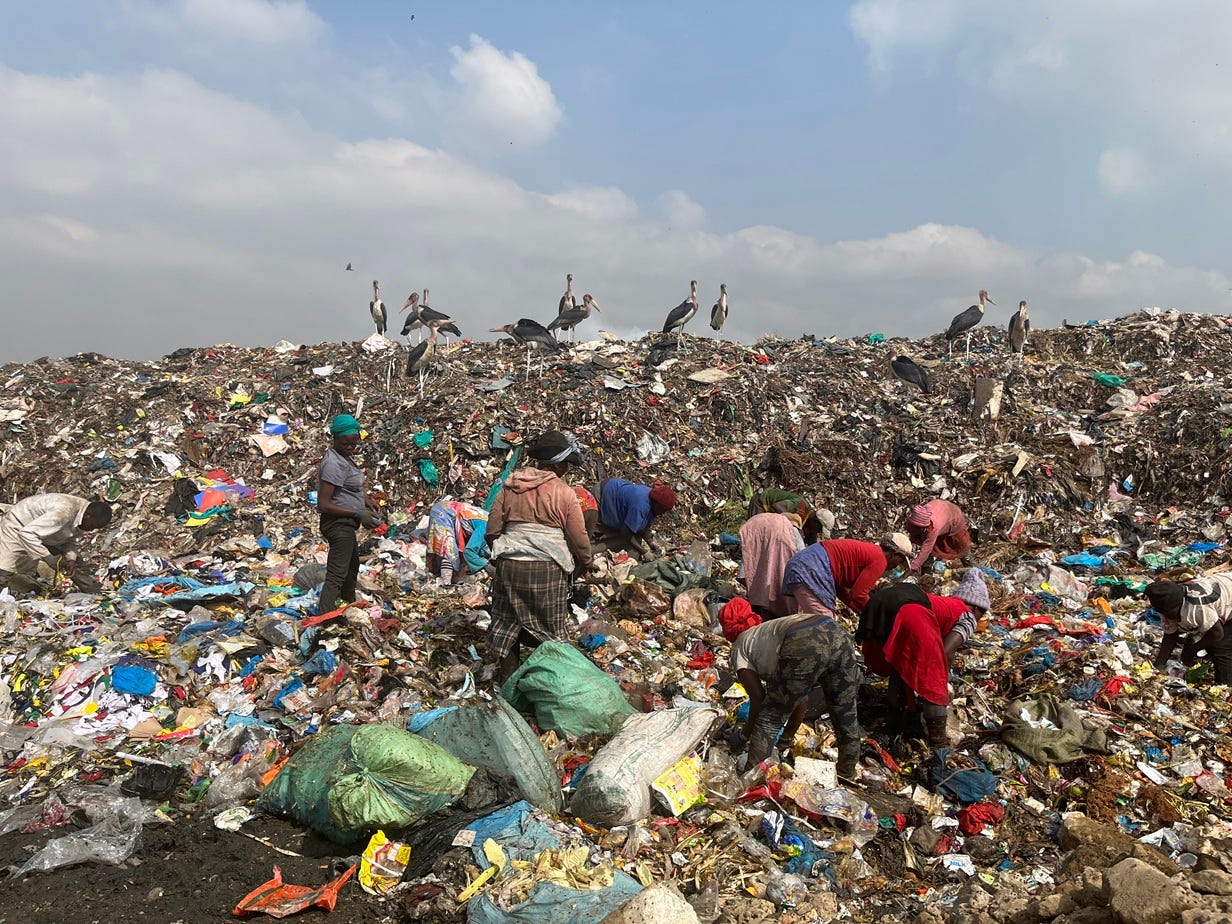
Markets like Kantamanto in Ghana are often portrayed as symbols of victimhood in a global waste chain. They are also sophisticated distribution nodes. Traders sort, repair, rework, and resell at scale. Informal innovation thrives under constraint.
But informal recycling cannot compensate for structural oversupply.
If Africa industrialises textiles, it must do so with waste built into the design logic:
Extended producer responsibility frameworks
Textile recycling and upcycling infrastructure
Incentives for durable design
Data systems for tracking inventory and demand
Circularity should not be an afterthought once landfills fill up. It should be embedded in cluster planning.
The continent has the opportunity to compress decades of trial and error into intentional design. It can leapfrog into blended models that combine manufacturing, brand development, and waste management from day one.
Capital Mispricing and Structural Blind Spots
Investors readily finance factories and industrial parks. They understand hard assets. They underwrite machinery and export contracts.
Creative economy capital, on the other hand, often focuses on storytelling, design, and brand building. It is less comfortable with supply chains, compliance audits, and environmental upgrades.
The result is a bifurcated funding landscape. Textiles are funded as industrial assets. Fashion brands are treated as fragmented SMEs. Waste management sits in another silo entirely.
The system remains under-capitalised because it is evaluated in parts rather than as a coherent ecosystem.
Reframing fashion and textiles as one integrated, impact-aligned asset class would align naturally with development finance mandates. The sector is labour-intensive. It disproportionately employs women. It has export potential. It intersects directly with climate mitigation and adaptation.
This is not a niche creative story. It is a structural development play.
Industrial Policy, Without Illusions
None of this is simple.
Energy reliability, logistics bottlenecks, currency volatility, and policy inconsistency remain real constraints across African markets. Competing with Asia on price alone is unrealistic. Building scale takes time.
But copying the West’s overproduction model would be even more unrealistic.
Africa does not need to become the next dumping ground for surplus inventory produced locally. It needs calibrated capacity aligned with real demand, cleaner production standards embedded at cluster level, and brands capable of capturing value rather than merely assembling garments.
Industrial policy must therefore connect agriculture, manufacturing, design, trade, and environment ministries. Cotton strategies must link to garment factories. Factories must link to brands. Brands must link to consumers. Waste systems must link back to design.
The more integrated the system, the less likely it is to drift toward uncontrolled overproduction.
The Competitive Advantage of Constraints
Africa’s constraints are often cited as weaknesses. They can also act as guardrails.
Limited capital enforces discipline. Smaller initial production runs encourage demand testing. Fragmented infrastructure pushes innovation at cluster level. Tight margins reward efficiency rather than excess.
The West’s overproduction model emerged in an era of cheap energy, loose regulation, and abundant capital. That context is shifting globally. Environmental regulation is tightening. Consumers are more aware. Supply chains are under scrutiny.
If African textile industrialisation is built around efficiency, traceability, and environmental performance from inception, it may align more closely with the direction the global market is heading than legacy systems built decades ago.
Late entry becomes strategic positioning.
From Downstream to Design
Africa did not create fashion’s waste crisis. But it lives with the consequences.
Remaining downstream, absorbing surplus and environmental spillover, is not a development strategy. Nor is blind replication of a model whose externalities are already visible.
The opportunity is harder and more ambitious: to industrialise with awareness.
To treat fashion and textiles as one system.
To embed sustainability at cluster level rather than retrofit it later.
To anchor production in domestic and regional demand.
To align capital with the full value chain rather than isolated segments.
If that alignment happens, sustainability will not be a compliance checkbox. It will be the continent’s competitive edge.
Africa can industrialise in fashion and textiles. The deeper question is whether it can design a system that the rest of the world will eventually need to copy.

A guest post by
A curious mind exploring the crossroads of creativity and insight.