


On July 24, at the University of Dar es Salaam, the Safal Kiswahili Prize for African Literature marked its tenth anniversary.
230 manuscripts submitted from seven countries. Three categories. Two winners. Tanzanian author Salim Hussein Ng’anzi took the Fiction prize for his novel Mwanamkasi Ndio Basi. Ali Hilal Ali, a repeat winner whose 2017 prize-winning manuscript was subsequently translated into English, won a PEN/Heim Translation Fund Grant, and is scheduled for release by University of Georgia Press in 2027, took the Poetry prize for Diwani ya Vizikwa Vya Kale.
Speaking on behalf of the judges, Professor Rayya Timammy of the University of Nairobi described the quality of submissions as evidence that “literary talent in Kiswahili continues to grow and flourish at a remarkable pace.”
230 manuscripts searching for a stage.
That number is the whole story of where African publishing sits right now.
What UNESCO Found
In 2025, UNESCO published the first comprehensive mapping of Africa’s book industry across all 54 countries.
The headline figure is $7 billion in annual revenue. Africa accounts for 5.4% of the global publishing market, which is valued at $129 billion. The continent represents 18% of the world’s population and generates just over one twentieth of the world’s book revenue.
The potential figure is $18.5 billion. That is what UNESCO projects the industry could reach if the right policies, investments, and structural reforms are implemented. Educational publishing alone represents a possible $13 billion of that ceiling, in a continent where school enrollment is rising, populations are young, and demand for learning materials is structurally embedded.
The gap between $7 billion and $18.5 billion is not a talent gap.
Nigeria produced over 15,000 book titles in the survey period. In 2021, every major global literary prize went to an African writer: the Nobel Prize for Literature to Abdulrazak Gurnah of Tanzania, the Prix Goncourt to Mohamed Mbougar Sarr of Senegal, the Booker Prize to Damon Galgut of South Africa. 230 Kiswahili manuscripts arrived in Dar es Salaam from seven countries for a single prize cycle. The pipeline of African literary talent is not the constraint.
The constraint is infrastructure. Policy. Distribution. And an import dependency that has kept Africa primarily a consumer of other people’s publishing rather than a producer of its own.

The Trade Deficit That Tells the Real Story
Africa imported books worth $597 million in 2023.
It exported books worth $81 million.
That is a 76% trade deficit in books. A continent with some of the world’s most recognised living writers, with literary traditions stretching back millennia, with over a billion potential readers, imports more than seven times what it exports in its own publishing sector.
The UNESCO report identifies the structural causes plainly: weak policies, an absence of tax incentives, and a chronic reliance on imported books, primarily from European publishers, for the educational publishing market that drives the majority of revenue.
Educational publishing is where the numbers are most stark. In Nigeria, Kenya, Ghana, South Africa, and Cameroon, school curriculum materials represent the largest segment of book spending. Governments in these countries have, for decades, structured procurement systems that privilege foreign publishers or rely on imported curriculum frameworks. The books that most African children learn from are often published elsewhere, edited elsewhere, and owned elsewhere.
That is not simply a cultural problem. It is an economic one. Every school textbook imported is revenue that does not circulate within the local publishing ecosystem. Every curriculum framework licensed from a foreign publisher is a contract that does not support a local editor, designer, printer, or distributor. The educational publishing market is the foundational economic layer of any publishing industry, and Africa’s version of it still runs primarily as a pipeline for foreign output.
The UNESCO report puts the size of the educational publishing opportunity at $13 billion alone. That figure requires no new audience. African children are already in schools. African governments are already buying curriculum materials. The question is where that spending flows.
What Is Already Being Built
The gap between where African publishing is and where it could be is not invisible to the people inside it.
Across the continent, 270 literary festivals and book fairs run annually, many with a specific focus on children’s books and emerging writers. UNESCO has designated Conakry, Accra, and Rabat as World Book Capitals in consecutive cycles, using the designation to galvanise national reading campaigns and strengthen local publishing ecosystems. Digital platforms are beginning to address the access infrastructure gap: Snapplify and Akoobooks offer ebooks and audiobooks that bypass the geographic and physical retail barriers that have historically limited African book distribution. AkooBooks in Ghana, eKitabu in Kenya, and African Storybook in South Africa are building digital reading infrastructure with specifically African audiences in mind.
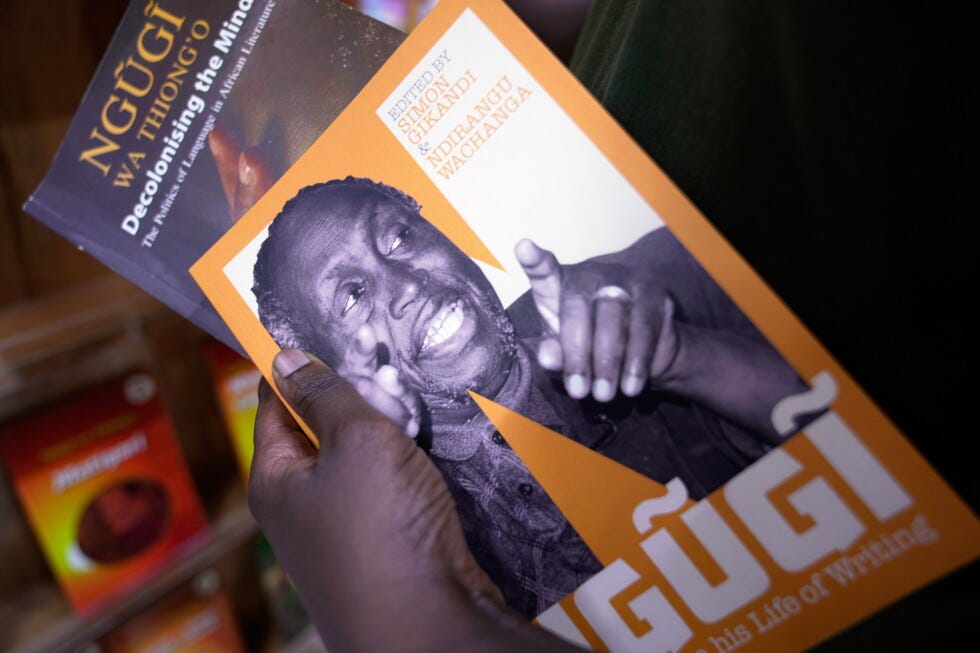
The Safal Kiswahili Prize itself is a structural intervention, not just an award. Founded in 2014 by Dr Lizzy Attree and Dr Mukoma wa Ngũgĩ, the son of Ngũgĩ wa Thiong’o, who died in May 2026 aged 87 and spent his career arguing that African literature in African languages was the continent’s most important cultural work, the prize was designed with a specific thesis: African languages deserve investment, visibility, and celebration. The winning entries are considered for publication by Tanzania’s Mkuki na Nyota Publishers, which has already published over 25 books from the prize’s history. The 2017 fiction winner’s manuscript is being published in English translation by a major American university press in 2027.
That pipeline, from Kiswahili manuscript to international English-language publication, is exactly what African publishing infrastructure needs more of. Not because African literature needs foreign validation. Because translation and international distribution are how a literary ecosystem builds commercial reach, and commercial reach is how it generates the revenue that sustains more writing, more publishing, and more of the infrastructure the sector needs.
The Ngũgĩ Question
The death of Ngũgĩ wa Thiong’o in May 2026 arrived at a specific moment in this conversation.
Ngũgĩ spent the second half of his career writing in Gikuyu rather than English, arguing that the decision to write in a colonial language was itself a form of cultural self-diminishment. He wanted African writers to write in African languages for African audiences first, and to reach the world through translation rather than by adopting the world’s linguistic infrastructure as their own.
The UNESCO report’s findings sit in direct dialogue with that argument.
Africa’s book industry generates $7 billion in a $129 billion global market. It has a 76% trade deficit in books. Its most commercially significant publishing segment, educational publishing, is dominated by foreign publishers operating in colonial languages. And its most internationally recognised literary figures, Chimamanda Ngozi Adichie, Teju Cole, Leila Slimani, NoViolet Bulawayo, write primarily in English or French for global audiences, published by houses in New York and London and Paris.
The Safal Kiswahili Prize is a counter-argument to that structure. 230 manuscripts in Kiswahili, not in English, submitted from Tanzania, Kenya, Uganda, and beyond. Judged by academics from the University of Nairobi, the State University of Zanzibar, and Makerere University. Awarded at the University of Dar es Salaam. Published by Mkuki na Nyota.
That is an African literary ecosystem operating in an African language, on African terms, building toward international reach through translation rather than starting from it.
It is also, at $5,000 for a first prize, funded at a level that reflects exactly the underfunding problem UNESCO is describing at the continental scale.
The Infrastructure Argument
One bookshop per 116,000 people.
One public library per 189,000 inhabitants.
Those are Africa’s physical book access numbers from the UNESCO report. They are not the numbers of a continent that does not want to read. They are the numbers of a continent whose book distribution infrastructure has not been built to match the population it serves.
The $18.5 billion ceiling is not primarily a demand problem. African readers exist. African writers exist. The 230 manuscripts submitted to the Safal Kiswahili Prize exist. The appetite is documented.
The ceiling is a supply-side infrastructure problem. It requires local publishing houses with enough capital to develop and print books at competitive cost. It requires distribution networks that can move books from publishers to readers in markets where most towns have no bookshop. It requires digital infrastructure that reaches the readers who cannot access a physical store. It requires educational procurement policies that prioritise locally published materials. It requires tax incentives for publishers that make domestic production economically viable against imported competition. It requires translation infrastructure that can take a Kiswahili prize-winning novel and get it to a reader in Lagos or Accra or Cape Town without routing through New York or London.
None of these are complicated ideas. They are the same infrastructure investments that built the publishing industries in France, Germany, South Korea, and Brazil. They are the same investments that the UNESCO report is explicitly recommending. They are the same investments that would move the needle from $7 billion to somewhere approaching $18.5 billion.
What they require is for governments and investors to treat publishing not as a cultural cost but as an economic sector with a documented return.
The Safal Kiswahili Prize has been doing that work for a decade with $5,000 prizes and the backing of a steel manufacturer.
Imagine what it could do with the infrastructure it deserves.

Written by Layo
Lead Editorial Writer, Creative Brief Africa
Outside of her editorial work, she writes Curious Health, a newsletter focused on everyday health questions, explored with clarity and care.