


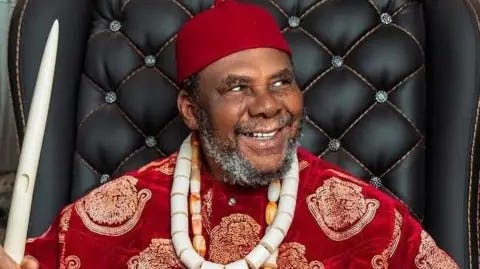
Africa’s creative industries are generous with applause and stingy with protection. A veteran can be honoured on stage, quoted in a hundred captions and named in a national statement, and still have no pension, no health cover and no one whose job it is to check on them. Edochie, who died in Enugu aged 79 after a long illness, was one of the lucky ones: he was honoured while alive, in Accra on 4 October. Most of his peers will not get even that, and none of them has a system behind the honour.
What did Pete Edochie’s death expose?
Within hours of the news, actor Muonago Collins posted on Instagram. “AS WE MOURN THE DEAD, WHO IS HELPING THE LIVING?” he wrote. He appealed for support for ailing veteran Ofili Ugbo, shared bank details for contributions to his hospital treatment, and said financial support for his recovery had been insufficient. He also criticised the industry’s habit of celebrating legends only after death.
Collins is one voice, but the pattern he describes is hard to dispute. The tribute was instant and unanimous. The help, if it comes, depends on whether a veteran’s story goes viral.
Why do Nollywood veterans keep ending up in public appeals?
Because the public appeal is the system. In Nollywood, the fallback for an elderly or sick actor is not an institution. It is a phone camera and an account number.
This year made the point repeatedly. Ten Nollywood actors died between January and August 2026 alone. In one case, the family and management of Yoruba screen veteran Taiwo Hassan “Ogogo” disclosed days before his death that he had stage four cancer and urgently needed medical intervention. By then, his family said, chemotherapy was no longer a viable option. He died on 23 August, aged 66. Care that starts after a diagnosis is terminal is not care. It is a goodbye with a fundraising link attached.
Olu Jacobs, who died on 16 September aged 84, shows the quieter version. Edochie publicly praised Joke Silva for six years of caring for her husband. The praise was earned, and it also shows who carried the burden: a spouse, at home, not a system.
What does the Actors Guild of Nigeria offer, and why does it not reach enough people?
The Actors Guild of Nigeria has a welfare arrangement on paper: a health insurance partnership with Medicard that has run since 2020. The reported uptake is where it falls apart. Under 2% of members are enrolled, and in one sponsored round of about 100 members, more than 80% never collected their ID cards.
That is not only a story of a guild failing its members. Insurance is a hard sell to people with irregular income, no payslip and a career that peaks young. A scheme that ignores how creatives actually get paid will keep getting 2% enrolment. Veterans, meanwhile, keep asking for the one thing that would reduce their dependence on appeals: royalties from work they already made.
What does South Africa’s SAMRO fund show, and where does it fall short?
South Africa offers the clearest contrast. The Southern African Music Rights Organisation runs a Retirement Annuity Fund that dates back to 1969, holds more than R490 million in assets, and counts more than 12,300 qualifying members. SAMRO funds it annually, and members can retire from age 55.
The fund is not a complete answer. It covers music, registered members and royalty income, so actors and the unregistered are left out. But it proves the model exists. A collecting body takes a share of what creative work earns and turns it into a pension, year after year, without anyone needing to go viral to be helped. Nollywood actors, who earn mostly from performance fees and not royalties, have no pipe feeding anything similar.

Is this only a Nigerian problem?
No, and the pan-African evidence is the strongest part of the case.
In Ghana, veteran actor Abeiku Nyame, known as Jagga Pee, asked President Mahama in August to set up a welfare fund for veteran actors, saying “this work, we don’t come on pension.” In September, actress Irene Opare made an emotional appeal to the president and urged government to support ageing actors while they are still healthy and able to work. The Ghana Actors Guild has long faced criticism on this point. Its spokesperson once called the trend of old actors seeking help on social media “very troubling,” and said court issues made it hard to roll out welfare and insurance packages.
Ghana’s music side shows what structure can do. The Musicians Union of Ghana created a welfare fund and mobilises corporate sponsorship and internally generated funds to support ageing musicians. For actors, a private scheme launched in January 2025 by Fiifi Coleman Productions with Hollard Insurance aims to secure the future of actors who are mostly left at the mercy of public funds when illness strikes in old age. It is a start, and it proves the point: it took a private producer, not the industry, to build it.
Kenya’s version is a royalty story. The Kenya Copyright Board revealed that artists received less than 10% of the royalties due to them in 2023. The regulator has since declined to renew the licence of the Music Copyright Society of Kenya, stopping it from collecting and distributing royalties. The society’s chief executive had earlier promised welfare support through a foundation, including medical cover for members. A welfare promise cannot outrun a collection system that is itself broken.
Who should pay for the care of Africa’s creative elders?
The industry that earned from their work, through three practical changes.
First, make care automatic, not charitable. A small, mandatory slice of what the industry earns, from performance fees, streaming deals and licensing, should flow into a pooled health and retirement fund, the way SAMRO’s does for songwriters.
Second, design for irregular income. Insurance that demands a fixed monthly premium from someone whose income arrives in lumps will keep producing 2% enrolment. Contributions deducted per project, at the point of payment, fit how creatives actually get paid.
Third, count the living. Guilds and collecting societies should keep a live register of veterans, with ages, health status and next of kin, so that support starts at 60 and not at the hospital gate.
A tribute is something the industry gives itself. Care is something it owes. The measure of a creative economy is not how loudly it mourns, but how many of its elders never have to ask.

Written by Layo
Lead Editorial Writer, Creative Brief Africa
Outside of her editorial work, she writes Curious Health, a newsletter focused on everyday health questions, explored with clarity and care.